


Reliable P-SAPEA-2023 Dumps Questions Available as Web-Based Practice Test Engine
Correct and Up-to-date SAP P-SAPEA-2023 BrainDumps
NEW QUESTION # 19
While discussing the Smart Battery initiative in greater detail with the appropriate stakeholder, as Chief Enterprise Architect of Wanderlust, you discover that several key areas such as value proposition, cost structure, revenue streams, partners, and channels have been worked upon in isolation and therefore do not tally with each other. Which artifact would you recommend to bring all the above key dimensions together in a single window, to have a unified, consistent, holistic view of the Smart Battery initiative?
- A. Business Model Canvas
- B. Statement of Architecture Work
- C. Business Strategy Map
- D. Architecture Principles
Answer: A
Explanation:
Explanation
A Business Model Canvas is a strategic management and entrepreneurial tool that allows you to describe, design, challenge, invent, and pivot your business model1. A Business Model Canvas consists of nine building blocks that cover the four main areas of a business: customers, offer, infrastructure, and financial viability2.
These building blocks are:
Value Proposition: The value that you deliver to your customers and the problem that you solve for them.
Customer Segments: The different groups of people or organizations that you aim to reach and serve.
Channels: The ways that you communicate with and deliver value to your customers.
Customer Relationships: The types of relationships that you establish and maintain with your customers.
Revenue Streams: The sources of income that you generate from your value proposition.
Key Resources: The most important assets that you need to create and deliver your value proposition.
Key Activities: The most important things that you do to create and deliver your value proposition.
Key Partnerships: The network of suppliers and partners that help you create and deliver your value proposition.
Cost Structure: The most significant costs that you incur to create and deliver your value proposition.
A Business Model Canvas is a useful artifact to bring all the key dimensions of the Smart Battery initiative together in a single window, to have a unified, consistent, holistic view of the initiative. By using a Business Model Canvas, you can:
Visualize the entire business model of the Smart Battery initiative on one page.
Identify the gaps, inconsistencies, or conflicts among the different elements of the business model.
Align the value proposition, cost structure, revenue streams, partners, and channels with the customer segments and their needs.
Test and validate your assumptions and hypotheses about the business model.
Iterate and improve your business model based on feedback and data.
Verified References: 1: https://www.strategyzer.com/canvas/business-model-canvas | 2:
https://www.investopedia.com/terms/b/business-model-canvas.asp
NEW QUESTION # 20
Which of the following set of artifacts does SAP provide as part of the SAP Reference Solution Architecture content?
- A. Solution Context Diagram/Solution Component Diagram/Solution Application Use-Case Diagram/Solution Value Flow Diagram.
- B. Solution Value Flow Diagram/Solution Process Flow Diagram/Solution Component Diagram/Solution Data Flow Diagram.
- C. Solution Value Flow Diagram/Solution Process Flow Diagram/Solution Component Diagram.
Answer: B
Explanation:
Explanation
The answer is A. Solution Value Flow Diagram/Solution Process Flow Diagram/Solution Component Diagram/Solution Data Flow Diagram.
The SAP Reference Solution Architecture (RSA) content provides a set of artifacts that can be used to describe the solution architecture for a SAP solution. These artifacts include:
Solution Value Flow Diagram - This diagram shows the flow of value through the solution, from the customer to the back-end systems.
Solution Process Flow Diagram - This diagram shows the detailed steps involved in a business process, and how the SAP solution supports those steps.
Solution Component Diagram - This diagram shows the different components of the SAP solution, and how they interact with each other.
Solution Data Flow Diagram - This diagram shows the flow of data through the SAP solution, from the source to the destination.
These artifacts can be used to understand the solution architecture for a SAP solution, and to communicate that architecture to others.
NEW QUESTION # 21
Your company adapts SAP's Integration Solution Advisory Methodology (ISA-M) as an Integration Solution Playbook. In your role as Lead Enterprise Architect, you are asked to decide which integration approach to take for this solution. Which of the following approaches is recommended by SAP ISA-M for identifying an integration solution and strategy?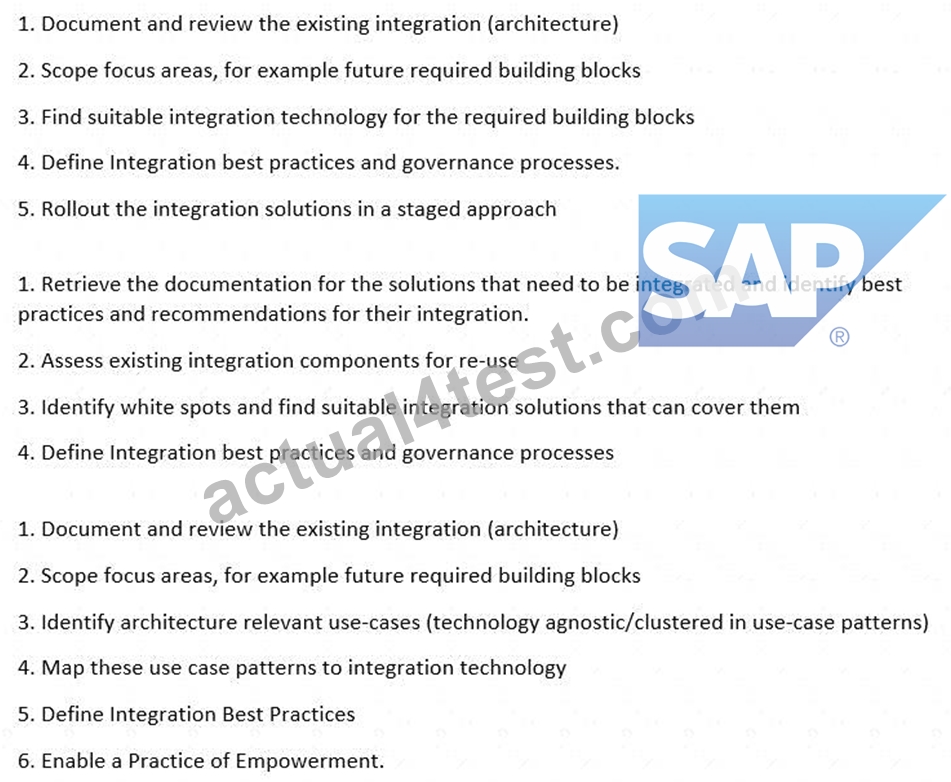
- A. 1.Document and review the existing integration (architecture)./2. Scope focus areas, for example future required building blocks/3. Identify architecture relevant use-cases (technology agnostic/clustered in use-case patterns)/4. Map these use case patterns to integration technology./5. Define Integration Best Practices./6. Enable a Practice of Empowerment.
- B. 1.Retrieve the documentation for the solutions that need to be integrated and identify best practices and recommendations for their integration./2. Assess existing integration components for re-use./3. Identify white spots and find suitable integration solutions that can cover them./4. Define Integration best practices and governance processes.
- C. 1.Document and review the existing integration (architecture)/2. Scope focus areas, for example future required building blocks/3. Find suitable integration technology for the required building blocks /4.
Define Integration best practices and governance processes./5. Rollout the integration solutions in a staged approach
Answer: A
Explanation:
Explanation
The best answer for the integration approach to take for this solution is C. According to the SAP Integration Solution Advisory Methodology (ISA-M), which is a methodology offered by SAP that helps enterprise architects define an integration strategy for their organizations and derive related integration guidelines, the recommended approach for identifying an integration solution and strategy is:
Document and review the existing integration (architecture). This step involves documenting and analyzing the current state of the integration landscape, including the integration scenarios, technologies, patterns, standards, and governance processes. The goal is to understand the strengths and weaknesses of the existing integration (architecture) and identify the gaps and improvement areas.
Scope focus areas, for example future required building blocks. This step involves defining and prioritizing the focus areas for the integration project, such as new or changed business requirements, integration scenarios, or technologies. The focus areas are derived from the gaps and improvement areas identified in the previous step, as well as from the business goals and drivers of the organization. The focus areas are also mapped to future required building blocks, which are logical components that represent the desired capabilities or functionalities of the integration solution.
Identify architecture relevant use-cases (technology agnostic/clustered in use-case patterns). This step involves identifying and describing the use-cases that are relevant for the integration project, such as process integration, data integration, user integration, or thing integration. The use-cases are technology agnostic, meaning that they do not specify any particular technology or service for implementation. The use-cases are also clustered in use-case patterns, which are generic templates that capture the common characteristics and requirements of similar use-cases.
Map these use case patterns to integration technology. This step involves mapping the use-case patterns to suitable integration technologies or services that can implement them. The mapping is based on a set of criteria and decision tables that consider various aspects of the use-case patterns, such as complexity, performance, security, or scalability. The mapping also takes into account the existing or planned integration technologies or services in the organization's landscape.
Define Integration Best Practices. This step involves defining and documenting the best practices and guidelines for designing, developing, testing, deploying, monitoring, and governing the integration solutions. The best practices and guidelines are based on SAP's recommendations and industry standards, as well as on the organization's specific needs and preferences. The best practices and guidelines also cover various aspects of the integration project, such as naming conventions, error handling, logging, tracing, or versioning.
Enable a Practice of Empowerment. This step involves enabling and empowering the different roles and personas involved in the integration project, such as integration architects, developers, testers, operators, or business users. The goal is to foster a culture of collaboration and innovation among the stakeholders, and to provide them with the necessary skills, tools, and resources to execute their tasks effectively and efficiently.
The other options (A and B) are not correct for the integration approach to take for this solution, because they either skip or misrepresent some of the steps in the SAP Integration Solution Advisory Methodology (ISA-M).
For example:
Option A is not correct because it does not include identifying architecture relevant use-cases (technology agnostic/clustered in use-case patterns), which is a key step to define and categorize the integration requirements in a generic way. It also does not include enabling a practice of empowerment, which is a key step to ensure the success and sustainability of the integration project.
Option B is not correct because it does not include documenting and reviewing the existing integration (architecture), which is a key step to understand the current state of the integration landscape and identify the gaps and improvement areas. It also does not include scoping focus areas or mapping use case patterns to integration technology, which are key steps to define and prioritize the future state of the integration solution.
For more information on the SAP Integration Solution Advisory Methodology (ISA-M) and its steps, you can refer to SAP Integration Solution Advisory Methodology: Template version 4.0 available now | SAP Blogs or Integration Solution Advisory Methodology (ISA-M): Define Integration Guidelines for Your Organization | SAP Blogs.
NEW QUESTION # 22
Why would you recommend building SAP Side-by-Side Extensions to an S/4HANA system based on SAP BTP?
- A. Extensions on SAP BTP technology can easily use of S/4HANA eventing.
- B. Extensions should be built on SAP BTP because SAP BTP is the only option for building a consistent user experience based on SAP Fiori UX styles.
- C. Extensions on SAP BTP can maintain SAP user and security context and allow the use of S/4HANA eventing.
Answer: C
Explanation:
Explanation
There are a few reasons why you would recommend building SAP Side-by-Side Extensions to an S/4HANA system based on SAP BTP.
SAP BTP is a cloud-based platform, which means that extensions can be developed, deployed, and managed in the cloud. This makes it easy to scale and manage extensions, and it also makes it easier to collaborate with other developers.
SAP BTP provides a number of services that can be used to build extensions, such as SAP Cloud Platform Integration and SAP Cloud Platform Event Mesh. These services can help to make extensions more scalable, reliable, and secure.
SAP BTP supports a variety of programming languages, which means that developers can use the language they are most comfortable with. This can help to make the development process more efficient and productive.
In addition to these reasons, SAP BTP also allows extensions to maintain SAP user and security context and allow the use of S/4HANA eventing. This is important because it ensures that users are only able to access the data and functionality that they are authorized to access, and it also allows extensions to react to events that occur in S/4HANA.
Therefore, SAP BTP is a good choice for building SAP Side-by-Side Extensions to an S/4HANA system.
Extensions on SAP BTP can maintain SAP user and security context, which means that the extensions can use the same authentication and authorization mechanisms as the S/4HANA system and respect the user roles and permissions defined in the S/4HANA system.
Extensions on SAP BTP can use S/4HANA eventing, which means that the extensions can subscribe to business events that are triggered by the S/4HANA system and react to them accordingly. For example, an extension can listen to a sales order creation event and perform some additional logic or integration based on the event data.
Extensions on SAP BTP can leverage the SAP Cloud Platform Integration Suite and the SAP HANA Data Management Suite, which provide a comprehensive set of services and tools for different integration scenarios, such as process integration, data integration, analytics integration, user integration, and thing integration.
Extensions on SAP BTP can benefit from the cloud-native capabilities of SAP BTP, such as scalability, elasticity, availability, and security. Extensions on SAP BTP can also take advantage of the various programming languages, frameworks, and technologies supported by SAP BTP, such as Java, Node.js, Python, Go, PHP, CAP, or serverless functions.
Verified References: 6:
https://help.sap.com/viewer/9d1db9835307451daa8c930fbd9ab264/2020.002/en-US/6f7b0c5a5e0d4f8a8b7c0e9c
NEW QUESTION # 23
Green Elk & Company is the world's leading manufacturer of agricultural and forestry machinery. The former company slogan "Elk always runs has recently been changed to "Elk feeds the world" One of Green Elk's strategic goals is to increase its revenue in the emerging markets of China, India, and other parts of Asia by 80 % within three years. This requires a new business model that caters to significantly smaller farms with limited budgets. You are the Chief Enterprise Architect and the CIO asked you to conduct interviews with the key stakeholders of Green Elk to assess the business strategy. You are planning to interview the owner of the business unit of finished goods. Which of the following sets of questions would you ask?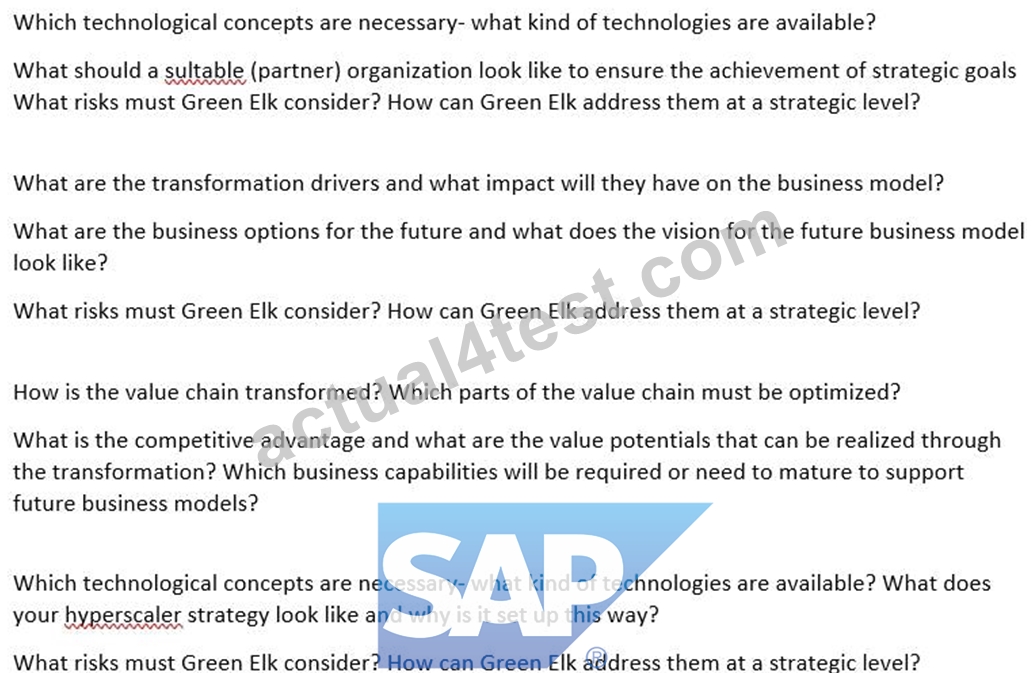
- A. Which technological concepts are necessary- what kind of technologies are available? What should a sultable (partner) organization look like to ensure the achievement of strategic goals What risks must Green Elk consider? How can Green Elk address them at a strategic level?
- B. Which technological concepts are necessary- what kind of technologies are available? What does your hyperscaler strategy look like and why is it set up this way? What risks must Green Elk consider? How can Green Elk address them at a strategic level?
- C. How is the value chain transformed? Which parts of the value chain must be optimized?What is the competitive advantage and what are the value potentials that can be realized through the transformation?
Which business capabilities will be required or need to mature to support future business models? - D. What are the transformation drivers and what impact will they have on the business model?What are the business options for the future and what does the vision for the future business model look like?What risks must Green Elk consider? How can Green Elk address them at a strategic level?
Answer: C
Explanation:
Explanation
According to the SAP Enterprise Architecture Framework, which is a methodology and toolset by the German multinational software company SAP that helps enterprise architects define and implement an architecture strategy for their organizations, the first phase of the architecture development cycle is the architecture vision, which involves defining the scope, objectives, and stakeholders of the architecture project, and creating a high-level vision of the desired outcome. The questions in option C are aligned with this phase, as they aim to understand and assess the business strategy and transformation drivers of Green Elk & Company, and to identify the value proposition, value chain, and business capabilities that are relevant for the new business model. The questions in option C are:
How is the value chain transformed? Which parts of the value chain must be optimized? This question helps to understand how the new business model affects the way Green Elk & Company creates and delivers value to its customers, and which activities or processes need to be improved or changed to support the new business model.
What is the competitive advantage and what are the value potentials that can be realized through the transformation? This question helps to understand what differentiates Green Elk & Company from its competitors, and what benefits or opportunities it can achieve by adopting the new business model.
Which business capabilities will be required or need to mature to support future business models? This question helps to identify the skills, resources, and competencies that Green Elk & Company needs to develop or enhance to enable and sustain the new business model.
The other options (A, B, D) are not correct for the set of questions to ask the owner of the business unit of finished goods, because they either skip or misrepresent some of the aspects of the architecture vision phase.
For example:
Option A is not correct because it focuses too much on the technological aspects of the architecture project, such as technological concepts, integration technology, and partner organization. These aspects are more relevant for later phases of the architecture development cycle, such as application architecture or technology architecture. The questions in option A do not address the business aspects of the architecture project, such as business goals, drivers, constraints, or value proposition.
Option B is not correct because it does not include asking about the value chain or the business capabilities, which are important aspects of the architecture vision phase. The value chain describes how Green Elk & Company creates and delivers value to its customers, and the business capabilities describe what Green Elk & Company can do or needs to do to achieve its goals. The questions in option B only focus on the transformation drivers and the future business model, which are not enough to define a comprehensive architecture vision.
Option D is not correct because it also focuses too much on the technological aspects of the architecture project, such as technological concepts and hyperscaler strategy. These aspects are not relevant for interviewing the owner of the business unit of finished goods, who is more concerned with the business aspects of the architecture project. The questions in option D do not address the value proposition or the value chain, which are essential for understanding how Green Elk & Company creates and delivers value to its customers.
For more information on the SAP Enterprise Architecture Framework and its phases, you can refer to SAP Enterprise Architecture Methodology Guide or SAP Enterprise Architecture Framework - Wikipedia.
NEW QUESTION # 24
Green Elk & Company is the world s leading manufacturer of agricultural and forestry machinery. The former company slogan "Elk always runs Elk feeds the world" One of Green Elk's strategic goals is to increase its revenue in the emerging markets of China, India, and other parts of Asia by 80 % within three years. This requires a new business model that caters tosignificantly smaller farms with limited budgets You are the Chief Enterprise Architect and the CIO asks you to assess the new business model for smaller farms with smaller budgets. By applying the Sustainable Business Model Canvas, which sequence of steps is best practice?
- A. 1. Assess and define the cost structure and revenue streams./2. Define the customer segments and value propositions/3. Detail the customer relationships and channels/4. Identify relevant key activities, key resources, and partners./5. Define the eco-social benefits and costs.
- B. 1 Assess and define the eco-social cost and benefits/2. Define the customer segments and value propositions/3. Detail the customer relationships and channels/4 Identify relevant key activities, key resources, and partners./5. Define revenue streams and cost structure.
- C. 1. Assess and define the value propositions for the small size farms customer segment/2. Detail the customer relationships and channels/3. Identify relevant key activities, key resources, and partners./4.
Define the revenue streams and cost structure./5. Define the eco-social benefits and costs. - D. 1. Assess and define the key resources, key activities, and partners./2. Define the customer segments and value propositions/3. Detail the customer relationships and channels 4. Define the revenue streams and cost structure./5. Define the eco-social benefits and costs
Answer: C
Explanation:
Explanation
According to the Sustainable Business Model Canvas, which is a tool that helps entrepreneurs to design and communicate their business models in a sustainable way, the recommended sequence of steps is:
Assess and define the value propositions for the small size farms customer segment. This step involves defining and describing the products or services that Green Elk & Company offers to its target customers, and how they create value for them. The value propositions should address the needs, problems, or desires of the customers, and highlight the benefits or advantages of Green Elk & Company's solutions over the alternatives.
Detail the customer relationships and channels. This step involves defining and describing how Green Elk & Company interacts with its customers, and how it reaches and delivers its products or services to them. The customer relationships should reflect the type and level of engagement that Green Elk & Company wants to establish and maintain with its customers, such as self-service, personal assistance, or community. The channels should reflect the most effective and efficient ways to communicate and distribute Green Elk & Company's value propositions to its customers, such as online platforms, physical stores, or partners.
Identify relevant key activities, key resources, and partners. This step involves identifying and describing the main activities, resources, and partners that Green Elk & Company needs to perform and leverage to create and deliver its value propositions to its customers. The key activities should reflect the most important tasks or processes that Green Elk & Company undertakes to execute its business model, such as production, marketing, or sales. The key resources should reflect the most essential assets or inputs that Green Elk & Company requires to execute its business model, such as human, physical, financial, or intellectual resources. The key partners should reflect the most strategic relationships or collaborations that Green Elk & Company establishes with other entities to execute its business model, such as suppliers, distributors, or competitors.
Define the revenue streams and cost structure. This step involves defining and describing how Green Elk & Company generates income from its customers, and how much it spends to execute its business model. The revenue streams should reflect the sources and mechanisms of income that Green Elk & Company obtains from selling its products or services to its customers, such as sales, subscriptions, or fees. The cost structure should reflect the types and amounts of expenses that Green Elk & Company incurs to execute its business model, such as fixed costs, variable costs, or economies of scale.
Define the eco-social benefits and costs. This step involves defining and describing how Green Elk & Company contributes to or affects the environment and society through its business model. The eco-social benefits should reflect the positive impacts or externalities that Green Elk & Company creates for the environment and society through its products or services, such as reducing emissions, improving health, or enhancing education. The eco-social costs should reflect the negative impacts or externalities that Green Elk & Company causes for the environment and society through its products or services, such as increasing waste, depleting resources, or harming biodiversity.
The other options (A, B, D) are not correct for the sequence of steps to apply the Sustainable Business Model Canvas, because they either skip or misrepresent some of the steps in this tool. For example:
Option A is not correct because it does not include assessing and defining the value propositions for the small size farms customer segment, which is a crucial step to understand and communicate how Green Elk & Company creates value for its customers. It also suggests defining the cost structure and revenue streams before defining the customer segments and value propositions, which is not a logical order since the latter determine the former.
Option B is not correct because it does not include identifying relevant key activities, key resources, and partners, which are important aspects of executing a business model. It also suggests retrieving the documentation for the solutions that need to be integrated instead of assessing and defining the value propositions for the small size farms customer segment, which is not relevant for designing a new business model.
Option D is not correct because it suggests assessing and defining the eco-social costs and benefits before defining the customer segments and value propositions, which is not a logical order since the latter determine the former. It also does not include detailing the customer relationships and channels, which are important aspects of delivering value to customers.
For more information on the Sustainable Business Model Canvas and its steps, you can refer to The Sustainable Business Canvas or Sustainable Business Model Canvas: A Review And Framework Development.
NEW QUESTION # 25
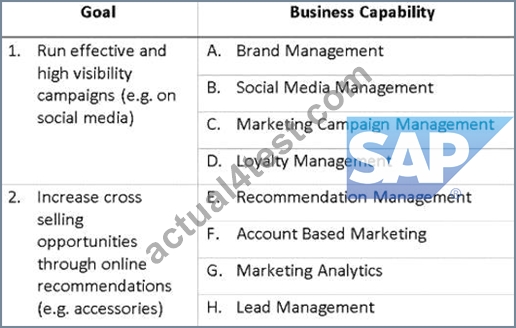
The Wanderlust CIO, along with you, the Chief Enterprise Architect, are in the process of deciding on the application that can potentially replace your existing online marketing application, and you are trying to create the artifact Business Footprint Diagram for decision support ( See table below) Which of the following combinations of goals, business capabilities, and applications would you recommend?
Note: There are 2 correct answers to this question,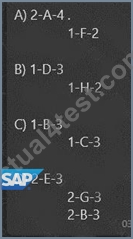
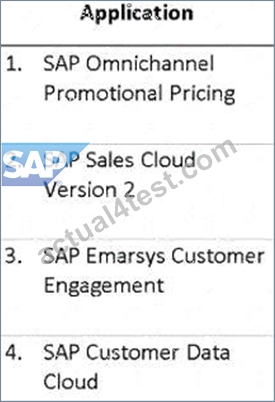
- A. 1-D-3,1-H-2
- B. 1-B-3,1-C-3
- C. 2-A-4,1-F-2
- D. 2-E-3,2-G-3,2-B-3
Answer: B,C
NEW QUESTION # 26
Which of the following are the best architectural decisions for an extension application in S/4HANA?
- A. Use 'Developer Extensibility" for data-intensive ABAP extensions to S/4HANA./Use "Side-by-Side Extensibility on SAP BTP. ABAP Environment" for applications that are less data-intensive and SAP BTP services that are intensively used.
- B. Use "Developer Extensibility for data-intensive ABAP extensions to S/4HANA./Use "Side-by-Side Extensibility on SAP BTP ABAP Environment" when additional SAP BTP services are intensively used and SAPUI5 user interfaces are required.
- C. Use "Developer Extensibility for ABAP extensions to S/4HANA that do not require a UI component./Use "Side-by-Side Extensibility on SAP BTP, ABAP Environment" for extensions that require a SAPUI5 based user interface.
Answer: A
Explanation:
Explanation
The explanation for the correct answer is as follows:
Developer Extensibility is a new extensibility option in SAP S/4HANA that enables customers and partners to create ABAP-based extensions within the SAP S/4HANA system, using public APIs and extension points provided by SAP1. Developer Extensibility is suitable for data-intensive ABAP extensions to S/4HANA, as it allows direct access to the underlying database and data models of SAP S/4HANA, without the need for additional replication or synchronization2. Developer Extensibility also supports the clean core paradigm, which ensures that the extensions are upgrade-stable and do not interfere with the core SAP code3.
Side-by-Side Extensibility on SAP BTP, ABAP Environment is another extensibility option in SAP S/4HANA that enables customers and partners to create ABAP-based extensions on a separate cloud platform, using public APIs and services provided by SAP4. Side-by-Side Extensibility on SAP BTP, ABAP Environment is suitable for applications that are less data-intensive and SAP BTP services that are intensively used, as it allows access to a variety of cloud-native services and capabilities, such as machine learning, integration, analytics, etc., without affecting the performance or stability of the SAP S/4HANA system. Side-by-Side Extensibility on SAP BTP, ABAP Environment also supports the cloud-ready development paradigm, which ensures that the extensions are scalable, secure, and compliant with cloud standards.
NEW QUESTION # 27
Which runtime environments does SAP directly support an SAP BTP?
- A. Kubemetes/SAP Business Technology Platform (BTP), ABAP environment
- B. OpenJDK for Java applications/Openshift for Kubernetes
- C. SAP BTP, Cloud Foundry environment/SAP Business Technology Platform (BTP), ABAP environment/SAP BTP, Kyma runtime
Answer: C
Explanation:
Explanation
SAP Business Technology Platform (BTP) is a suite of cloud-based platform-as-a-service (PaaS) offerings from SAP. BTP provides a variety of runtime environments for running applications, including:
SAP BTP, Cloud Foundry environment: This is a popular runtime environment for running Java, Node.js, and Python applications.
SAP Business Technology Platform (BTP), ABAP environment: This is a runtime environment for running ABAP applications.
SAP BTP, Kyma runtime: This is a runtime environment for running Kubernetes-based applications.
In addition to these runtime environments, BTP also provides a number of other services, such as:
Database services: BTP provides a variety of database services, including SAP HANA, MySQL, and PostgreSQL.
Messaging services: BTP provides a variety of messaging services, such as SAP Cloud Platform Integration and SAP Cloud Platform Event Mesh.
Storage services: BTP provides a variety of storage services, such as SAP Cloud Platform Object Storage and SAP Cloud Platform File Storage.
BTP is a comprehensive platform that provides a variety of services for running applications and managing data. The different runtime environments available in BTP allow you to choose the right environment for your specific needs.
SAP BTP supports multiple runtime environments for different purposes and skill sets. A runtime environment is any runtime that hosts applications and services. An SAP BTP environment provides integration into the SAP BTP account model, cockpit, and permissions management10. The following are the runtime environments that SAP directly supports on SAP BTP:
SAP BTP, Cloud Foundry environment: This environment allows you to create polyglot cloud applications in Cloud Foundry. It supports various programming languages, such as Java, Node.js, Python, Go, and PHP. It also provides a code-to-container packaging and deployment model, platform-managed application security patching and updates, automatic application routing, load balancing, health checks, and multilevel self-healing.
It also supports the Cloud Application Programming Model (CAP), which is an opinionated framework for developing business applications.
SAP Business Technology Platform (BTP), ABAP environment: This environment allows you to create ABAP-based cloud applications within the Cloud Foundry environment. It supports the ABAP programming language and the ABAP RESTful Programming Model (RAP), which is a framework for developing RESTful services and user interfaces. It also provides an integrated development lifecycle and enables you to reuse existing on-premise ABAP assets.
SAP BTP, Kyma runtime: This environment provides a fully managed cloud-native Kubernetes application runtime based on the open-source project "Kyma". It supports various programming languages and models, such as Node.js, Python, Go, Java, CAP, and serverless functions. It also provides a built-in service mesh, eventing framework, API gateway, service catalog, and service binding capabilities. It enables you to develop highly scalable, microservice-based applications and user-centric process extensions.
Verified References: 10:
https://help.sap.com/docs/btp/architecture-and-development-guide-for-industry-cloud-solutions/runtimes-environ
| : https://help.sap.com/docs/btp/sap-business-technology-platform/environments
NEW QUESTION # 28
Which artifacts does SAP provide as part of the SAP Reference Business Architecture content?
- A. Business Process Model/Solution Process Model
- B. Business Capability Model/Business Process Model
- C. Business Capability Model/Business Data Model/Business Role Model/Product Map
Answer: B
Explanation:
Explanation
The SAP Reference Business Architecture content provides a set of artifacts that can be used to describe the business architecture of an organization. These artifacts include:
Business Capability Model: This model describes the capabilities that an organization needs to have in order to achieve its business goals.
Business Process Model: This model describes the processes that an organization uses to deliver its products and services.
Business Data Model: This model describes the data that an organization uses to support its business processes.
Business Role Model: This model describes the roles that people play in an organization.
Product Map: This map shows how the different products and services that an organization offers are related to each other.
The SAP Reference Business Architecture content is a valuable resource for organizations that are looking to improve their business architecture. It provides a common language and set of concepts that can be used to describe the business architecture of an organization.
However, it is important to note that the SAP Reference Business Architecture content is just a starting point.
Organizations will need to tailor the content to their specific needs.
NEW QUESTION # 29
Having identified the appropriate sel of Business Activities, as the Chie Enterprise Architect of Wanderlust, assisted by the sap Enterprise Architects. you have been trying to relate to Lead to Cash Business Capabilities in the SAP Reference Business Architecture content repository. In light of the two key goals outlined by the Wanderlust CIO, what are the most appropriate Business Capabilities? Note:
There are 3 correct answers to this question.
- A. Marketing Strategy Management, Brand Management
- B. Marketing Campaign Management
- C. Social Media Management
- D. Account Based Marketing, Lead Management
- E. Marketing Analytics, Recommendation Management
Answer: B,C,E
NEW QUESTION # 30
Tho Wanderlust CIO wants to focus loss on marketing strategy and planning, to instead prioritize marketing implement goals in mind to enhance number of leads generated:
* Run effective and highly visible campaigns (for example. on social media)
* Increase cross selling opportunities through online recommendation
AS the Chief Enterprise Architect Of Wanderlust. assisted by the SAP Enterprise Architects, you have been trying to re goals with the Business Process Modules, Segments and Activities in the Lead to Cash B2C Business Process Varia Business Architecture content repository (see graphic below).
What are relevant combinations Of business activities and goals based on the graphic below?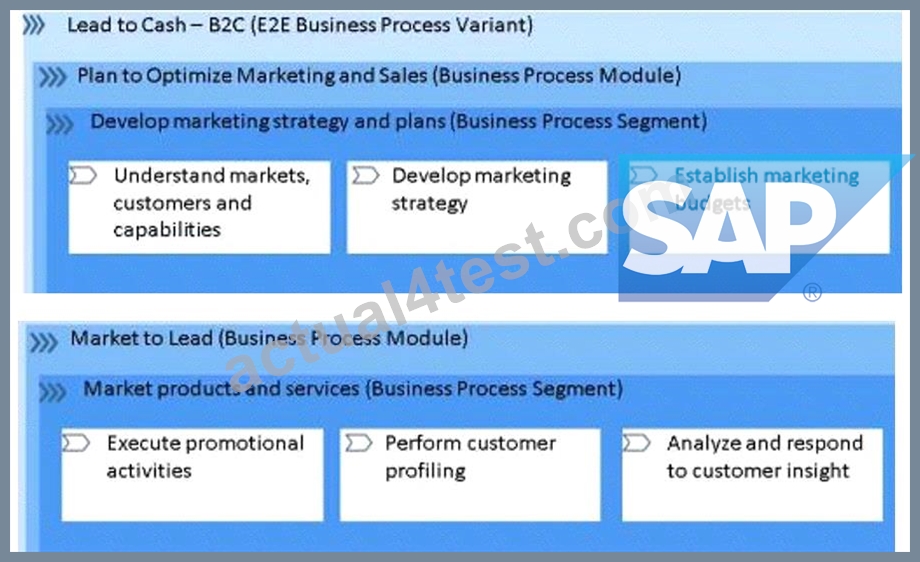
Note: There are 2 correct answers to this question.
See the Image
- A. Develop market strategy -Run effective and high visibility campaigns.
- B. Implement promotional activities-Run effective and high visibility campaigns.
- C. Design and mange a customer loyalty program- increase cross selling opportunities through online recommendations.
- D. Analyse and respond to customer insight- increase cross selling opportunities through online recommendations.
Answer: B,D
Explanation:
Explanation
Analyse and respond to customer insight is a business activity that is related to the Customer Insight segment of the Lead to Cash B2C Business Process Variant. This business activity can help Wanderlust to identify opportunities to increase cross selling through online recommendations.
Implement promotional activities is a business activity that is related to the Promotion segment of the Lead to Cash B2C Business Process Variant. This business activity can help Wanderlust to run effective and highly visible campaigns on social media.
The other two options, Develop market strategy and Design and mange a customer loyalty program, are not as relevant to the goals that Wanderlust is trying to achieve.
Develop market strategy is a business activity that is related to the Marketing Strategy segment of the Lead to Cash B2C Business Process Variant. This business activity is more focused on the overall marketing strategy of Wanderlust, rather than the specific goals of increasing cross selling or running effective campaigns.
Design and mange a customer loyalty program is a business activity that is related to the Customer Relationship Management segment of the Lead to Cash B2C Business Process Variant. This business activity is more focused on building long-term relationships with customers, rather than the specific goals of increasing cross selling or running effective campaigns.
Therefore, the best course of action is to focus on the Analyse and respond to customer insight and Implement promotional activities business activities in order to achieve Wanderlust's goals of increasing cross selling and running effective campaigns.
NEW QUESTION # 31
When creating an application architecture roadmap, the WHAT and WHERE are defined in a rather straightforward way, while the WHOM may differ by context. Multiple roadmap clusters may apply a variety of WHOM dimensions. For example, procurement vs. asset management. Which of the following definitions are correct? Note. There are 3 correct answers to this question.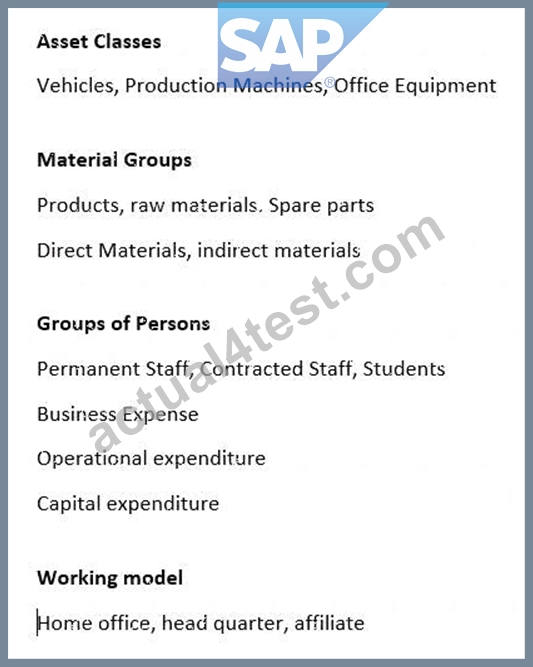
- A. Asset Classes/Vehicles, Production Machines, Office Equipment
- B. Working model/Home office, head quarter, affiliate
- C. Groups of Persons/Permanent Staff, Contracted Staff, Students/Business Expense/Operational expenditure/Capital expenditure
- D. Material Groups/Products, raw materials. Spare parts/Direct Materials, indirect materials
Answer: B,C,D
Explanation:
Explanation
The WHOM dimension of an application architecture roadmap defines the different groups of stakeholders or users that are involved in or affected by the application. The WHOM dimension can vary depending on the context and the scope of the roadmap. For example, in the context of procurement vs. asset management, the WHOM dimension could include material groups/products, groups of persons, and working model as possible clusters. These clusters represent different categories of items, people, and locations that are relevant for the procurement and asset management processes. For example:
Material groups/products: This cluster could include different types of materials or products that are procured or managed by the organization, such as raw materials, spare parts, direct materials, or indirect materials. These categories could have different requirements, standards, or regulations that affect the application architecture.
Groups of persons: This cluster could include different types of people that are involved in or benefit from the procurement and asset management processes, such as permanent staff, contracted staff, or students. These groups could have different roles, responsibilities, or access rights that affect the application architecture.
Working model: This cluster could include different modes or locations of work that are supported by the procurement and asset management processes, such as home office, head quarter, or affiliate. These modes or locations could have different technical, legal, or organizational implications that affect the application architecture.
The other option (A) is not a correct definition of a WHOM dimension cluster, because it does not represent a group of stakeholders or users, but rather a group of assets or resources that are managed by the organization.
Asset classes/vehicles, production machines, and office equipment are examples of WHAT dimension clusters, which define the different types of assets or resources that are relevant for the application architecture.
Verified References: Strategic Architecture Roadmap for Composable Enterprise Applications, What is an application architecture?, Phase C: Information Systems Architectures - Application Architecture
NEW QUESTION # 32
You design a Solution Architecture, based on SAP S/4HANA, for an internationally active customer that has a national subsidiary in China and other countries that have special requirements for data storage. As the responsible Enterprise Architect, your task is to propose a solution that takes these special requirements into account. How do you proceed when your customer's Architecture Guideline calls for following a "cloud-first" approach?
- A. This depends on the required solution components. Public cloud solutions may not meet the necessary data protection requirements. Therefore, private cloud or on-premise options must be considered when developing the solution landscape.
- B. This depends on the required solution components. None of the selected SAP solutions may support the regulated environment, so alternative solutions or custom developed solutions should be considered.
- C. This is independent of the solution components required, because SAP S/4HANA Cloud and all SAP SaaS solutions meet all applicable data protection requirements, Private cloud or on-premises options therefore do not need to be considered. The "cloud-first" approach can be fully implemented.
Answer: A
Explanation:
Explanation
The customer's architecture guideline calls for following a "cloud-first" approach, but this does not mean that all solutions must be deployed in the cloud. In some cases, private cloud or on-premise options may be necessary to meet the customer's data protection requirements.
For example, if the customer's subsidiary in China requires that data be stored within China, then a private cloud solution in China may be the best option. Similarly, if the customer's other subsidiaries have different data protection requirements, then a hybrid solution that combines cloud and on-premise deployments may be necessary.
The Enterprise Architect must carefully consider the customer's specific requirements and constraints before making a decision about the deployment environment.
Here are some of the factors that the Enterprise Architect should consider:
The customer's data protection requirements: The Enterprise Architect must understand the customer's specific data protection requirements and ensure that any solution meets those requirements.
The availability of cloud-based solutions that meet the customer's requirements: Not all cloud-based solutions meet the same data protection requirements. The Enterprise Architect must ensure that the cloud-based solutions that are being considered meet the customer's requirements.
The cost of different deployment options: The Enterprise Architect must consider the cost of different deployment options, including cloud, private cloud, and on-premise.
The scalability and performance requirements of the solution: The Enterprise Architect must ensure that the solution meets the customer's scalability and performance requirements, regardless of the deployment environment.
By carefully considering all of these factors, the Enterprise Architect can make a decision about the deployment environment that meets the customer's specific requirements and constraints.
NEW QUESTION # 33
As part of the mapping of a Business Architecture to the Solution Architecture, an Environment & Location Diagram must be developed in the Technology Architecture phase. In this context, numerous architecture decisions have to be made. Among other things, you must check which SAP BTP services and which SAP SaaS solutions are available as part of the Solution Architecture in which data center of the desired hyperscaler. How do you go about this validation?
- A. I use the SAP Business Accelerator Hub (api.sap.com) because it provides all the required information regarding SAP BTP service and SAP SaaS solution availability for each hyperscaler, in a central location.
- B. I use the SAP Discovery Center to check in which data centers the respective SAP BTP services and the SAP SaaS solutions are available.
- C. I use the SAP Discovery Center to check which of the selected SAP BTP services are offered by which hyperscaler. With help from the SAP Trust Center, I check in which data center the involved SAP SaaS solutions are available.
Answer: C
Explanation:
Explanation
According to the SAP Discovery Center 1 and the SAP Trust Center 2, the steps involved in this validation are:
Use the SAP Discovery Center to check which of the selected SAP BTP services are offered by which hyperscaler. The SAP Discovery Center is a platform that provides access to SAP BTP services, events, and related resources, and helps you to implement your use cases on SAP BTP with step-by-step guidance and support from topic experts and SAP Community. In the Service Catalog section of the SAP Discovery Center, you can browse and filter the available SAP BTP services by category, region, or hyperscaler. You can also compare the features and pricing of different services, and learn how to use them in your projects.
Use the SAP Trust Center to check in which data center the involved SAP SaaS solutions are available.
The SAP Trust Center is a platform that provides information on cloud performance, security, privacy, and compliance. In the Certification and Compliance section of the SAP Trust Center, you can find certificates, reports, and attestations that show how SAP meets various industry standards and regulatory requirements. You can also filter the documents by solution, region, or hyperscaler, and download them for your reference.
The other options (A and C) are not correct for how to validate the availability of SAP BTP services and SAP SaaS solutions in the desired hyperscaler's data center, because they either do not exist or do not provide the required information. For example:
Option A is not correct because there is no such platform as SAP Business Accelerator Hub (api.sap.com) that provides all the required information regarding SAP BTP service and SAP SaaS solution availability for each hyperscaler. The correct name of the platform is SAP API Business Hub (api.sap.com), which is a platform that provides access to SAP APIs, events, and related resources, but it does not provide any information on the availability of SAP BTP services or SAP SaaS solutions for each hyperscaler or data center.
Option C is not correct because the SAP Discovery Center does not provide any information on the availability of SAP SaaS solutions for each hyperscaler or data center. The SAP Discovery Center only provides information on the availability of SAP BTP services for each hyperscaler or region, but not for specific data centers. To check the availability of SAP SaaS solutions for each data center, you need to use the SAP Trust Center instead.
NEW QUESTION # 34
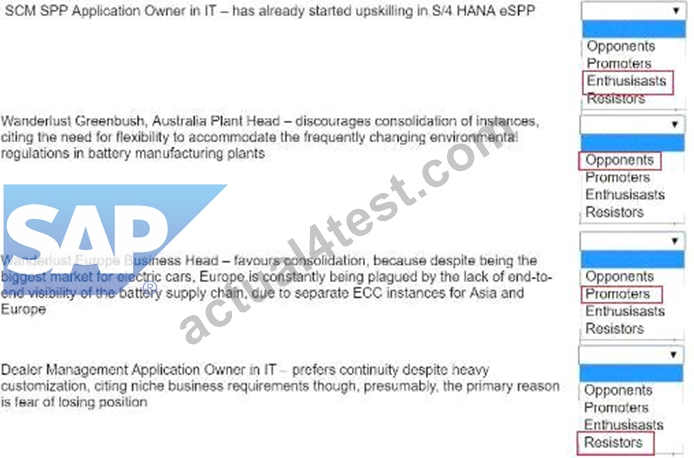
While trying to identify and map key stakeholders in Wanderlust, you, as the Chief Enterprise Architect, have been evangelizing the strategic business and IT objectives with business and IT departments across regions and taking in their views on the upcoming business transformation, Match the feedback from stakeholders (shown on the left) to the categorization and to some of the actions in the dropdown lists.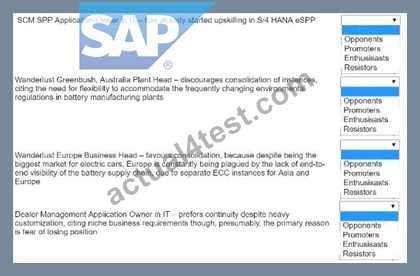
Answer:
Explanation: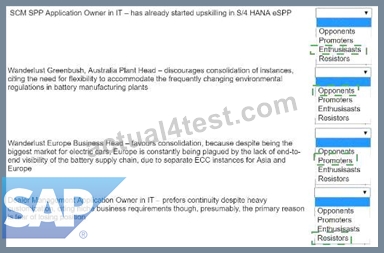
NEW QUESTION # 35
As a result of solution mapping, business capabilities might require services which partners have implemented in SAP BTP. Which SAP components and services, if any, are required to integrate such BTP partner services with an on-premise SAP S/4HANA system (hybrid scenario)?
- A. SAP HANA Cloud Connection, and the corresponding SAP Data Provisioning Agent, to make the on-premises system available to applications and services in a given SAP BTP sub account. Preferably use the SAP BTP Destination Service.
- B. SAP Cloud Connector to make the on-premises system available to applications and services in a given SAP BTP sub account. Preferably use the SAP BTP Destination Service in combination with Cloud Connector.
- C. No other components are required to make an SAP on-premise backend system securely accessible over SAP BTP SAP BTP automatically establishes secure connections in SAP backend systems.
Answer: B
Explanation:
Explanation
In a hybrid scenario, where business capabilities require services which partners have implemented in SAP BTP and an on-premise SAP S/4HANA system, the following SAP components and services are required to integrate such BTP partner services with the on-premise system:
SAP Cloud Connector: The SAP Cloud Connector is a software component that allows you to connect your on-premise SAP systems to SAP BTP. The Cloud Connector provides a secure connection between your on-premise system and SAP BTP, and it also makes your on-premise system available to applications and services in SAP BTP.
SAP BTP Destination Service: The SAP BTP Destination Service is a service that provides a single point of entry for accessing on-premise systems from SAP BTP. The Destination Service makes it easy to manage and secure connections to on-premise systems, and it also provides a way to federate data from different on-premise systems.
In order to integrate BTP partner services with an on-premise SAP S/4HANA system, you will need to install the SAP Cloud Connector on your on-premise system and register the Cloud Connector with SAP BTP. You will also need to create a destination in the SAP BTP Destination Service for your on-premise system. Once you have done this, you will be able to access the on-premise system from applications and services in SAP BTP.
It is important to note that you can also use other SAP components to integrate on-premise systems with SAP BTP. However, the SAP Cloud Connector and the SAP BTP Destination Service are the most commonly used components for this purpose.
To integrate BTP partner services with an on-premise SAP S/4HANA system, you need to use the SAP Cloud Connector, which is a reverse proxy that establishes a secure connection between your on-premise system and your SAP BTP subaccount5. The Cloud Connector acts as a bridge between your on-premise network and a trusted subaccount on SAP BTP6. It allows you to access resources in your on-premise network from applications running on SAP BTP without exposing your internal landscape to the internet7.
To simplify the configuration and consumption of the Cloud Connector connection, you can use the SAP BTP Destination Service, which is a service that allows you to define and manage destinations for accessing remote systems from applications running on SAP BTP8. A destination is a set of properties that contains information such as the URL, authentication method, proxy type, and additional parameters of a remote system9. By using the Destination Service, you can centrally manage and securely store the connection details of your on-premise system and consume them from your BTP partner services.
Verified References: 5:
https://help.sap.com/viewer/cca91383641e40ffbe03bdc78f00f681/Cloud/en-US/e6c7616abb5710148cfcf3e75d96
| 6:
https://help.sap.com/viewer/cca91383641e40ffbe03bdc78f00f681/Cloud/en-US/8d3b28a7c1644a1c9d1ee165ec0
| 7:
https://help.sap.com/viewer/cca91383641e40ffbe03bdc78f00f681/Cloud/en-US/e54cc8fbbb571014a4d9e7f02f9f
| 8:
https://help.sap.com/viewer/cca91383641e40ffbe03bdc78f00f681/Cloud/en-US/3cb7b81115c44cf594e0e363129
| 9:
https://help.sap.com/viewer/cca91383641e40ffbe03bdc78f00f681/Cloud/en-US/e54f70d327154aa0a4ba36ce7ac4
NEW QUESTION # 36
......
100% Reliable Microsoft P-SAPEA-2023 Exam Dumps Test Pdf Exam Material: https://examtorrent.actual4test.com/P-SAPEA-2023_examcollection.html