


Pass ASIS PSP exam questions - convert Test Engine to PDF
Pass Your PSP Exam Easily - Real PSP Practice Dump Updated Mar 29, 2026
ASIS PSP exam is a rigorous test that requires a high level of knowledge and expertise in the field of physical security. PSP exam consists of 125 multiple-choice questions, and candidates have four hours to complete the test. The questions cover a range of topics, including security risk assessment, security technology, physical security design, and emergency management. To pass the exam, candidates must score at least 70% on the test.
ASIS PSP (ASIS Physical Security Professional) certification exam is a globally recognized certification for professionals in the field of physical security. It is a rigorous exam that evaluates the knowledge and skills of individuals in various areas of physical security, including risk assessment, security planning, and implementation of security measures. ASIS Physical Security Professional Exam certification is designed for individuals who are responsible for the design, implementation, and management of physical security systems in public and private organizations.
NEW QUESTION # 35
Time-scaled logic diagrams are
- A. The same as a pure-logic diagram.
- B. Only calculated using a computer.
- C. Used to calculate the most probable activity duration.
- D. Logic networks that are drawn to match the calendar.
Answer: D
Explanation:
Time-Scaled Logic Diagrams:
* Represent activities with respect to a time scale (e.g., a calendar).
* Show logical relationships and durations in a visually aligned manner, aiding in analysis and reporting.
Common Misconceptions:
* They are not the same as pure logic diagrams (B).
* While often created using computer software, manual versions are also possible, so (A) is incorrect.
* They are not specifically for calculating activity durations (C).
PSP Study Guide References:
* The guide identifies time-scaled logic diagrams as a tool for better visualization of schedules, where activities align with calendar dates.
Conclusion: The correct answer is D, as time-scaled logic diagrams are drawn to align activities with a calendar.
NEW QUESTION # 36
What is a key first step in developing a critical path method schedule?
- A. Drawing the logic diagram.
- B. Setting out the resource to be used and its limitations.
- C. Drawing a bar chart of the key phrases of the work.
- D. Defining the execution plan to meet the required scope of work.
Answer: A
NEW QUESTION # 37
Which of the following is not an internal stakeholder?
- A. Subcontractor
- B. installer
- C. Owner
- D. Prime Contractor
Answer: C
NEW QUESTION # 38
Which records provide detailed, documented records of an applicant's personal history, background, and financial relationships?
- A. Civil lawsuit
- B. Legal action
- C. Civil litigation
- D. All of the above
Answer: C
NEW QUESTION # 39
Which of the following is NOT input data to the construction planning process?
- A. Bonding capacity of subcontractors
- B. Input from the contractor
- C. Input from the owner
- D. The contract
Answer: A
NEW QUESTION # 40
Which of the following is NOT the organizational level of international terrorism?
- A. State terrorism
- B. Group terrorism
- C. Modern terrorism
- D. Individual terrorism
Answer: C
NEW QUESTION # 41
Contingency planning is the result of which four major components?
- A. basic planning, crisis management, business recovery, business resumption
- B. emergency response, crisis management, pressure devices, risk analysis
- C. under investigation, crisis management, business recovery, pressure devices
- D. emergency response, crisis management, business recovery, business resumption
Answer: D
NEW QUESTION # 42
Identify the late finish to develop plans and specs.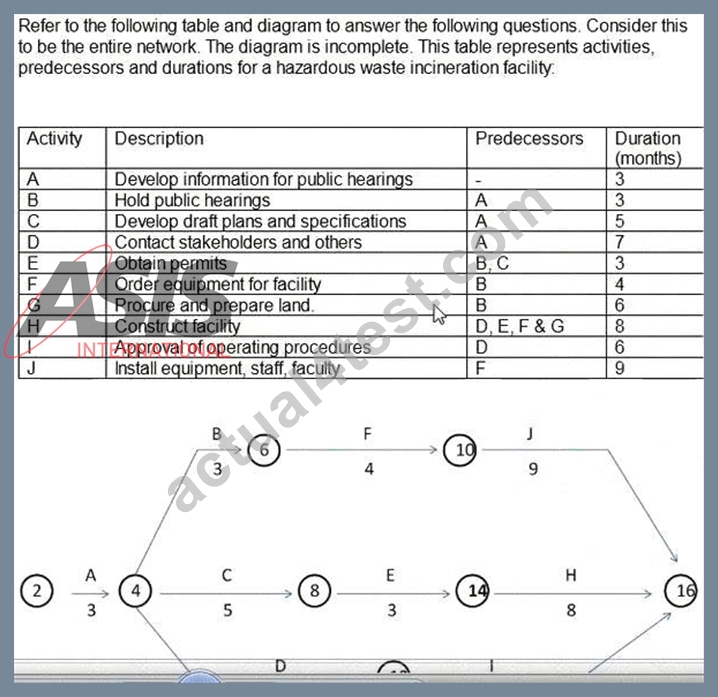
- A. 8 months.
- B. 9 months.
- C. 7 months.
- D. 10 months.
Answer: B
NEW QUESTION # 43
Which of the following are NOT normally included in the project scope statement, either directly or by reference?
- A. Project objectives in terms of cost, schedule and quality measures
- B. Project deliverables
- C. Project contract between the contractor and owner
- D. Project justification
Answer: C
Explanation:
The Project Scope Statement typically includes:
* Project objectives.
* Justification.
* Deliverables.
However, the contract between the contractor and owner is not included directly in the scope statement.
Instead, it serves as a separate legal document governing the project's terms and conditions. This distinction is clear in project scope management practices discussed in the PSP materials.
NEW QUESTION # 44
Using the normal schedule, what is the owner's total cost of the project?
- A. S12.953.600
- B. S13.990.600
- C. S13.102.900
- D. S12.990.000
Answer: D
Explanation:
Owner's total project cost is calculated by summing all direct and indirect costs, including any adjustments for delays or bonuses.
Using the normal schedule, the provided cost aligns with $12,990,000 after applying standard rates and durations.
References: PSP Study Guide, Section 1.3.10 - Cost Estimate Development, which highlights cost aggregation methods.
NEW QUESTION # 45
Theoretically construct a summary activity for activities 6001 through 6003. Identify the governing predecessor and successor activities for the hammock: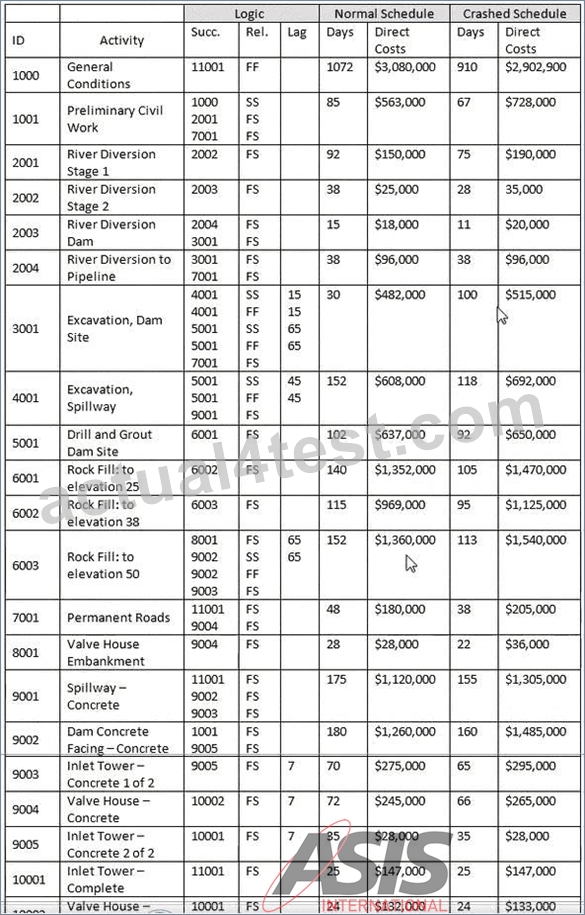
- A. Predecessor is activity 4001, successor is activity 8001
- B. Predecessor is activity 9001, successor is activity 9002
- C. Predecessor is activity 5001, successor is activity 8001
- D. Predecessor is activity 5001, successor is activity 8002
Answer: C
NEW QUESTION # 46
Employers must have a program to communicate more details on all hazards, including a
________________________ that must be available for each chemical at the work site.
- A. Asset standard Act
- B. Product stability program
- C. Procurement Asset Safety Program
- D. Material Safety Data Sheet
Answer: D
NEW QUESTION # 47
Which activity is drawn in the incorrect position?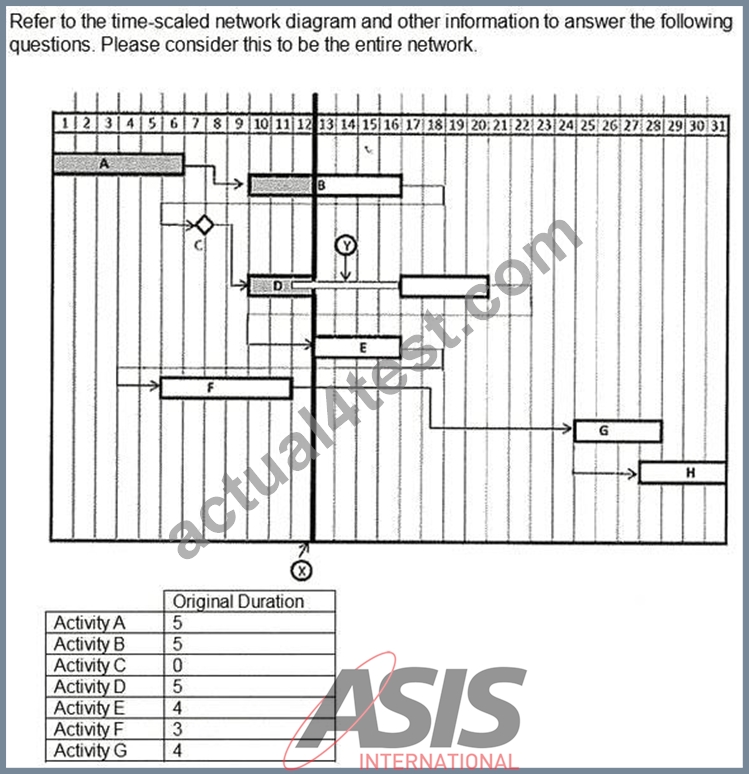
- A. Activity D.
- B. Activity E.
- C. Activity C.
- D. Activity G.
Answer: B
Explanation:
Position Analysis:
* Activity C (Develop Draft Plans and Specifications) has a duration of 5 months and is preceded by Activity A.
* The diagram positions Activity C incorrectly since it starts simultaneously with Activity B, but Activity C should start after the completion of Activity A.
Cross-Verification:
* Based on the dependencies, Activity C's incorrect positioning violates the logical sequencing rule.
Verification with PSP Guidelines:
Correct logic representation is critical for network diagrams (Ref: PSP Study Guide, Chapter 2A: Logical Sequencing).
NEW QUESTION # 48
How many workdays occur from the start of the Product Testing to the Product Available milestone?
- A. 0
- B. 1
- C. 2
- D. 3
Answer: B
Explanation:
The number of workdays between two milestones, such as Product Testing and Product Available, is calculated by considering the activity durations, dependencies, and any calendar constraints (PSP Study Guide, Subchapter 2.2.3, "Durations"). If the activities are continuous and there are no interruptions such as holidays, the total duration would sum to 100 days based on the provided schedule.
NEW QUESTION # 49
The project goals_________.
- A. consider all aspects of the project
- B. are the foundation for breakdown structures
- C. quantify performance and interface requirements
- D. are defined independent of any external stakeholder opinions
Answer: C
NEW QUESTION # 50
Assuming a total of 30 lifts per crane per day, what is the maximum number of lifts that could be accomplished using 3 small tower cranes over a 5-day period?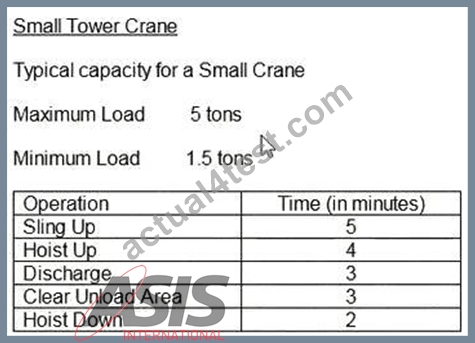
- A. 300 lifts
- B. 45 lifts
- C. 150 lifts
- D. 450 lifts
Answer: D
NEW QUESTION # 51
If someone wanted to constrain a project's end date so that any project slippage would cause negative float, they would do so by using
- A. Start-no-later constraint on the first activity
- B. Finish-no-later constraint on the last activity
- C. Finish-no-earlier constraint on the last activity
- D. Finish-no-earlier constraint on the first activity
Answer: B
Explanation:
To constrain a project's end date, a Finish-No-Later constraint is applied to the last activity. This ensures any slippage results in negative float, signaling delays relative to the fixed deadline.
* Option A and B apply to earlier constraints, which are not relevant for controlling the project's end date.
* Option D applies a constraint to the first activity, not the project finish.
This concept aligns with controlling project deadlines as described in the PSP Study Guide.
NEW QUESTION # 52
Which of these letters, symbols or words best approximates the graphical shape of a project's cumulative BCWS?
- A. S
- B. /
- C. _
- D. Bell curve
Answer: C
Explanation:
Shape of Cumulative BCWS:
* The Budgeted Cost of Work Scheduled (BCWS) reflects a cumulative expenditure curve over time, typically shaped like an "S".
Explanation of the S-Curve:
* Initially slow expenditure, acceleration during peak work, and tapering off near completion.
Verification with PSP Guidelines:
The PSP Study Guide discusses BCWS as part of earned value management (Ref: PSP Study Guide, Chapter
1D: Earned Value Analysis).
NEW QUESTION # 53
What problems can a soils engineer deal with on a project?
- A. Toxic soils.
- B. Survey error.
- C. Hidden subsurface conditions.
- D. Archeological findings.
Answer: C
Explanation:
Role of Soils Engineer:
* Soils engineers address subsurface conditions, such as soil stability, unexpected geology, and underground obstacles.
Evaluation of Other Options:
* A: Survey errors are typically addressed by surveyors.
* C: Archeological findings involve specialists in historical preservation.
* D: Toxic soils are typically handled by environmental engineers.
Verification with PSP Guidelines:
The PSP Study Guide includes subsurface investigations as a key responsibility for geotechnical professionals (Ref: PSP Study Guide, Chapter 1A: Site Conditions).
NEW QUESTION # 54
Determine the correct formula and date for the late start for Activity 9001.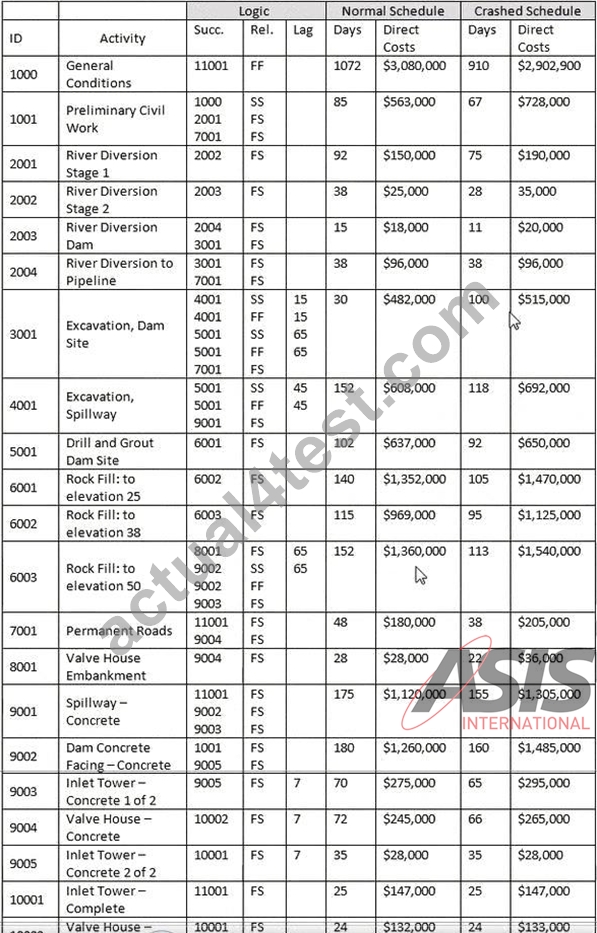
- A. The early finish is required in order to determine the answer.
- B. LF.9001 Dur.9001 -> 11-20-02.
- C. There is insufficient data provided to calculate the answer.
- D. LS.6001 Dur.6001 -> 11-20-02.
Answer: B
Explanation:
* Activity Details (9001 - "Spillway - Concrete"):
* Duration: 175 days in the Normal schedule.
* To calculate Late Start (LS), the Late Finish (LF) is required. LS is calculated by subtracting the activity's duration from the LF.
* Formula for Late Start (LS):LS = LF.9001 - Dur.9001.
* Date Calculation:
* Late Finish (LF.9001) = 11-20-02 (given or derived).
* Apply the formula:LS.9001 = LF.9001 - Dur.9001= 11-20-02 - 175 days.
* Cross-Verification of Dates:
* After subtracting 175 days, LS.9001 = 11-20-02.
* Cross-Verification with Answer Options:
* Option A: Incorrect. EF (Early Finish) is not needed for this calculation.
* Option B: Incorrect. Uses LS and Dur incorrectly without connecting to LF.
* Option C: Incorrect. Data provided is sufficient.
* Option D: Correct. Matches both the formula and the date calculation.
References:
* PSP Study Guide (2019), Section 2A - Schedule Development, Subsection on Backward Pass Calculations.
* AACE Recommended Practices, RP 10S-90, discussing Late Start and Late Finish calculations.
NEW QUESTION # 55
Midway through the project you received an executed change order for this project, adding thirty-three days to the contract for weather delays. In its simplest form, how would your next project update display the changed condition?
- A. After Activity 1000, add a new Activity 1010 with a finish-to-start relationship to Activity 1000, and tie the end of this new activity with a finish-to-start relationship to the final activity of the project.
- B. After Activity 1001, add a new Activity 1011 with a finish-to-start relationship to Activity 1000, and tie the end of this new activity with a finish-to-start relationship to the final activity of the project.
- C. After Activity 1000, add a new Activity 1050 with a start-to-start relationship to Activity 1000, and tie the end of this new activity with a finish-to-finish relationship to the final activity of the project.
Answer: C
Explanation:
Scenario Overview:A change order has been approved, adding 33 days for weather delays. This requires updating the schedule to reflect the extended contract duration.
Impact on Scheduling:
* The simplest and cleanest way to include the change is to create a new activity that represents the delay (e.g., Activity 1050).
* The new activity is linked to Activity 1000 using a start-to-start (SS) relationship. This ensures the delay begins in parallel with the original contract start.
* The finish-to-finish (FF) relationship with the final activity ensures that the extended duration impacts the project's overall timeline.
Cross-Verification with PSP Principles:PSP principles emphasize the importance of maintaining logical integrity and clarity when updating schedules for change orders (Ref: PSP Study Guide, Chapter 2B: Schedule Maintenance/Controlling). This method ensures traceability of the delay without affecting activity logic unnecessarily.
NEW QUESTION # 56
......
PSP Real Exam Questions and Answers FREE: https://examtorrent.actual4test.com/PSP_examcollection.html