


Instant Download Network Appliance: NS0-593 Free Updated Test Dumps
Valid NS0-593 FREE EXAM DUMPS QUESTIONS & ANSWERS
NEW QUESTION # 11
You ate connecting a Windows Server 2019 hostto ISCSI LUNs on a 4-node AFF A250 cluster running
NetApp ONIAP 9.8 software. The host is unable to connect to the target interface, and the ONTAP event log
has the message shown below.
ISCSI: network interface identifier disabled for use; incoming connection discarded
In this scenario, what is the cause of this connection issue?
- A. The iSCSI service is not enabled on the interface.
- B. The WWPN was not added to the initiator group.
- C. iSNS is not enabled on the storage virtual machine.
- D. CHAP isnot configured correctly for the specified initiator.
Answer: B
NEW QUESTION # 12
A customer reports that some of their client computers are unable to access a FlexGroup over CIFS. This problem involves only their older Windows XP clients and some printers and scanners.
In this scenario, which statement Is correct?
- A. FlexGroup requires CIFS shares to use the Continuously Available Feature, which these clients do not support.
- B. These systems use Offloaded Data Transfer, which is an unsupported feature in FlexGroup.
- C. These systems use the SMQI protocol which Is an unsupported feature in FlexGroup
- D. FlexGroup requires CIFS shares to be located in qtrees, which these clients do not support.
Answer: A
Explanation:
FlexGroup requires CIFS shares to use the Continuously Available Feature, which enables transparent failover and recovery of SMB sessions in the event of a node failure or takeover. This feature is only supported by Windows 8 and later clients, and some printers and scanners may not support it either. Therefore, these older Windows XP clients and some printers and scanners are unable to access a FlexGroup over CIFS. Reference = Supported and unsupported configurations for FlexGroup volumes, NetApp ONTAP FlexGroup volumes - Best practices and implementation guide (page 24)
NEW QUESTION # 13
You have a NetApp ONTAP cluster consisting of four NetApp FAS8200 controllers with two NetApp CN1610 cluster switches running ONIAP 9.8 software. You are receiving several alert messages stating that the cluster network has degraded. After troubleshooting, you determine that the errors are being generated from Node 2, interface e0b.
In this scenario, what should you do first to solve this problem?
- A. Replace both NetApp CN1610 switches.
- B. Replace the motherboard on Node 2.
- C. Replace the NetApp CN1610 switch that connects to Node 2, interface e0b.
- D. Replace the Twinax cable between Node 2, Interface e0b. and the NetApp CN1610 switch.
Answer: D
Explanation:
A Twinax cable is a type of copper cable that is used to connect cluster ports to cluster switches1.
A cluster port is a network port that is configured for cluster communication and data access2.
A cluster switch is a network switch that is used to interconnect the nodes in a cluster and provide redundancy and load balancing3.
A cluster network is a network that enables cluster communication and data access between the nodes in a cluster and external clients4.
A cluster network can be degraded due to various reasons, such as misconfiguration, malfunction, or excessive link errors on the cluster ports or the cluster switches.
Link errors are errors that occur on the physical layer of the network, such as CRC errors, length errors, alignment errors, or dropped packets.
Link errors can indicate a problem with the cable, the switch port, the network interface card (NIC), or the cable connector.
In this scenario, the alert messages state that the cluster network has degraded and the errors are being generated from Node 2, interface e0b.
The first step to solve this problem is to replace the Twinax cable between Node 2, interface e0b and the NetApp CN1610 switch, as this could be the source of the link errors.
Replacing the cable could resolve the issue and restore the cluster network to a healthy state.
If replacing the cable does not solve the problem, then other steps may be required, such as checking the switch port, the NIC, or the cable connector, or replacing the switch or the motherboard. Reference:
1: Cluster network cabling, ONTAP 9 Documentation Center
2: Cluster ports, ONTAP 9 Documentation Center
3: Cluster switches, ONTAP 9 Documentation Center
4: Cluster network, ONTAP 9 Documentation Center
[5]: How to troubleshoot CLUSTER NETWORK DEGRADED error messages, NetApp Knowledge Base
[6]: Cluster network degraded due to high CRC errors on cluster ports, NetApp Knowledge Base
NEW QUESTION # 14
After expanding a two-node AFF A300 cluster with two AFF A700 nodes, you observe latencies when data is accessed indirectly. The system node run -node -command netstat command shows retransmits and packet drops on the LIFs. The AFF A700 nodes with 40 Gbps and the AFF A300 connect with 10 Gbps to the cluster interconnect. You are using Cisco Nexus 3132Q cluster interconnect switches. You just updated to ONTAP 9.8 software.
In this scenario, what is causing this problem?
- A. The 10 Gbps to 10 Gbps cluster Interconnect is creating a speed mismatch.
- B. AFF A300 and AFF A700 node mixing Is not supported in ONTAP 9.8 software.
- C. The AFF A300 Is using an adapter card for the cluster Interconnect, but only onboard ports are supported.
- D. There is an NXOS firmware mismatch, verify in the Interoperability Matrix (1MTJ for a supported version.
Answer: A
Explanation:
A speed mismatch occurs when the cluster ports on different nodes have different speeds, such as 10 Gbps and 40 Gbps1.
A speed mismatch can cause packet loss, retransmits, and latency on the cluster network, especially when data is accessed indirectly, meaning that the node serving the data is different from the node hosting the LIF2.
In this scenario, the AFF A300 nodes have 10 Gbps cluster ports, while the AFF A700 nodes have 40 Gbps cluster ports, creating a speed mismatch on the cluster interconnect34.
The Cisco Nexus 3132Q cluster interconnect switches support both 10 Gbps and 40 Gbps cluster ports, but they have a shallow buffer size of 9 MB per port, which can be easily overwhelmed by the bursty traffic generated by the speed mismatch.
To solve this problem, you need to either upgrade the cluster ports on the AFF A300 nodes to 40 Gbps, or downgrade the cluster ports on the AFF A700 nodes to 10 Gbps, to achieve a homogeneous cluster interconnect1.
Alternatively, you can use QoS policies to limit the bandwidth of the cluster ports to avoid oversubscription and congestion on the cluster interconnect. Reference:
1: Cluster network cabling, ONTAP 9 Documentation Center
2: Cluster Network Latency - Troubleshooting Guide, NetApp Knowledge Base
3: AFF A300 Tech Specs, NetApp
4: AFF A700 Tech Specs, NetApp
[5]: Why do network speed mismatches create problems with shallow buffered switches?, NetApp Knowledge Base
[6]: How to use QoS to limit the bandwidth of cluster ports, NetApp Knowledge Base
NEW QUESTION # 15
Your customer has mounted an NFS SVM from a Linux client unci performance is very poor. The customer is certain that they have jumbo frames enabled. They have verified an MTU of 9000 on both the Linux client and the broadcast domain on the NetApp ONTAP 9.8 cluster.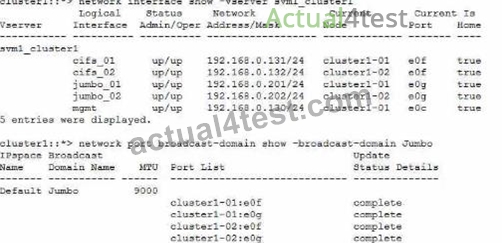
Referring to the exhibit, which ONTAP command will help isolate a possible MTU mismatch?
- A.

- B.

- C.

- D.

Answer: A
Explanation:
The ONTAP command that will help isolate a possible MTU mismatch is network ping -lif jumbo_01 -vserver svm1_cluster1 -destination 192.168.0.210 -disallow-fragmentation true -packet-size 5000. This command will send a ping packet of 5000 bytes from the logical interface (LIF) jumbo_01 to the destination IP address 192.168.0.210, without allowing fragmentation. If the ping fails, it means that there is an MTU mismatch somewhere along the path. If the ping succeeds, it means that the MTU is consistent and the problem is elsewhere12. Reference: 1: Check the MTU network setting on the storage system | NetApp Documentation 2: How to adjust the MTU for an ONTAP interface - NetApp Knowledge Base
NEW QUESTION # 16
Your customer wants to access a LUN on a FAS 8300 system from a VMware ESXi server through the FC
protocol. They already created a new SVM, volume. LUN, and igroup for this purpose. The customer reports
that the server's FC HBA port Is online, but the LUN does not show up.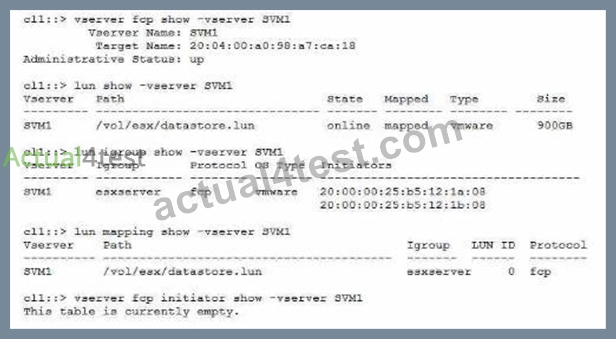
Referring to the exhibit, what is the reason for this problem?
- A. The LUN Is not mapped to the correct SCSI ID.
- B. The esxserver igroup contains incorrect IQNs.
- C. The FC service has not been configured on the SVM.
- D. The zoning on the FC switches Is Incorrect.
Answer: A
NEW QUESTION # 17
Your customer noticed in NetApp Active IQ that their NetApp Cloud Volumes ONTAP for Azure HA solution is no longer sending AutoSupport messages over HTTPS. A support ticket has been opened to find out why. No changes have been made to the Cloud Volumes ONTAP for Azure HA environment.
In this scenario, which two autosupport command parameters should be used to validate that AutoSupport Is working properly? {Choose two.)
- A. -mail-hosts
- B. -transport
- C. -proxy-url
- D. -to
Answer: B,C
Explanation:
= The -transport parameter specifies the protocol used to send AutoSupport messages, which should be HTTPS by default. The -proxy-url parameter specifies the proxy server used to send AutoSupport messages, which should be the Connector's IP address and port if the Cloud Volumes ONTAP nodes do not have outbound internet access. These two parameters can be used to check the AutoSupport configuration and connectivity status. Reference = Verify AutoSupport setup, Troubleshoot your AutoSupport configuration, High-availability pairs in Azure
NEW QUESTION # 18
You recently discovered the error message shown below in your ONTAP logs.
What should be your first action to correct this Issue?
- A. Use the wafliron command against my_data_vol to solve the inconsistency on the volume.
- B. Determine the root cause behind the inconsistency before attempting any recovery procedure.
- C. Use the storage takeover command on the storage controller that contains my_data_vol.
- D. Power cycle all the disk storage shelves that contain drives of the aggregate with the my_data_vol volume.
Answer: B
Explanation:
= The error message indicates that the volume my_data_vol is WAFL inconsistent, which means that there is a discrepancy between the data blocks and the metadata in the file system. This can be caused by various factors, such as hardware failures, software bugs, power outages, or network disruptions. The first action to correct this issue is to determine the root cause behind the inconsistency before attempting any recovery procedure, as recommended by the NetApp documentation1. This is because some recovery procedures, such as wafliron or storage takeover, may not work or may cause further damage if the underlying cause is not resolved. For example, if the inconsistency is due to a faulty disk or shelf, running wafliron may not fix the problem and may even corrupt more data. Therefore, it is important to identify and isolate the cause of the inconsistency before taking any further steps. Reference = 1 Volume Showing WAFL Inconsistent - NetApp Knowledge Base
NEW QUESTION # 19
Your customer is running a NetApp AFF A800 system with NetAppONTAP 9.8 software and states that their
NS224 shelf is not showing with the correct shelf ID. You analyze the data and the shelf shows an
identification of "1.SHFHUXXXXXXXXXX."
What is the cause of the reported Issue?
- A. A new shelf was added to the controller.
- B. The shelf was cabled Incorrectly.
- C. The shelf has been power cycled.
- D. The shelf had a disk replaced too quickly.
Answer: A
NEW QUESTION # 20
Your customer complains that u host will constantly report losing a connection to the iSCSl target and then report that the session was reestablished.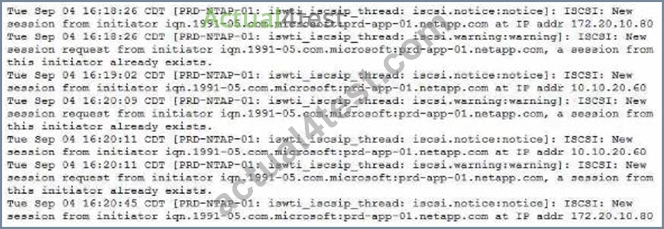
As shown in the exhibit, what is a cause of this flapping?
- A. A host with an IP address of 172.20.10.80 and a second host with an IP address of 10.10.20.60 are accessing the same LUN.
- B. A host with an IP address of 172.20.10.80 and a second IP address of 10.10.20.60 is accessing different LUNs.
- C. A host with an IP address of 172.20.10.80 and a second host with an IP address of 10.10.20.60 are in different initiator groups.
- D. A host with an IP address of 172.20.10.80 and a second host with an IP address of 10.10.20.60 have the same IQN.
Answer: D
Explanation:
IQN stands for iSCSI Qualified Name, which is a unique identifier for an iSCSI initiator or target1.
ONTAP uses IQN to authenticate and authorize iSCSI sessions2.
If two hosts have the same IQN, they will cause a conflict and ONTAP will reject the new session request from the second host3.
This will result in the host losing the connection to the iSCSI target and then reporting that the session was reestablished, as shown in the exhibit.
To avoid this problem, each host should have a unique IQN. Reference:
iSCSI Qualified Name (IQN) - NetApp
iSCSI authentication and authorization - NetApp
Troubleshooting iSCSI issues - NetApp
[Configuring iSCSI initiators - NetApp]
NEW QUESTION # 21
A user mentions that their home drive, that Is an export within a volume, is no longer allowing them to save files. The drive reports that it Is full, even though It shows that minimal data is written to it.
Which statement would explain this behavior?
- A. Other users wrote to this user's home drive.
- B. The mount is stale and uses a cached version of the volume.
- C. The client system needs to remount the export to show the proper space.
- D. Other files within the volume are also owned by the user, exceeding the user quota.
Answer: D
Explanation:
= A user quota is a limit on the amount of disk space or the number of files that a user can consume on a volume. A user can be represented by multiple IDs, such as UNIX user ID (UID), Windows user ID (SID), or name mapping ID. A file owned by any of these IDs is subject to the restriction of the user quota. If a user has files in different directories or qtrees within the same volume, all of those files count towards the user's quota limit. Therefore, if other files within the volume are also owned by the user, they could exceed the user quota and prevent the user from saving more files to their home drive, even if the home drive itself shows minimal data usage. Reference = How quotas work with users and groups overview, ONTAP - How quotas work with users and groups
NEW QUESTION # 22
A system panic due to an "L2 watchdog timeout hard reset" error occurred. You have found a FIFO message in the SP log.
Which FIFO message Is useful for Investigating this Issue?
- A. before Reset BBSP:C=00 L=00 FIFO:
- B. before NMI BBSP:C=00 L=00 FIFO: F3 F2 F1 F0 5 B2 0 0 0 80 20 E F E3 C0 C2 3 4 6 7 9 9 A
- C. BIOS exit BBSP:C=2F L=20 FIFO: 2 C8 C9 C4 24 4 6 18 7 8 11
- D. ONTAP Shutdown BBSP:C=00 L=2F FIFO:
Answer: B
Explanation:
= The FIFO message before NMI is useful for investigating the issue because it shows the state of the system before the non-maskable interrupt (NMI) was triggered by the L2 watchdog timeout. The FIFO message contains information about the CPU registers, the stack pointer, the instruction pointer, and the last executed instructions. This can help identify the cause of the system hang or deadlock that led to the watchdog reset. The other FIFO messages are not useful because they show the state of the system after the reset or shutdown, which may not reflect the original problem. Reference = https://kb.netapp.com/onprem/ontap/hardware/Handling_L2_Watchdog_Resets_on_the_FAS8200_and_AFF_A300_platforms
https://docs.netapp.com/us-en/ontap-metrocluster/install-ip/task_sw_config_restore_defaults.html
NEW QUESTION # 23
Your customer calls you because one application is not able to access a NetApp ONTAP S3 bucket. While reviewing the EMS log on the cluster, you see the following message:
The same credentials work in another application.
In this scenario, what would cause this problem?
- A. The application is using v4 signatures.
- B. The application is trying to log in as an anonymous user.
- C. The application is trying to access using the HTTP protocol.
- D. The application is using v2 signatures.
Answer: D
Explanation:
The error message indicates that the access is denied for user 'anonymous user' (Vserver 50), from client IP 10.10.10.10 accessing resource '/offload-target'. This means that the application is not providing a valid user name or access key to authenticate with the ONTAP S3 server. According to the NetApp documentation1, ONTAP S3 server supports both v2 and v4 signatures, but v2 signatures are deprecated and not recommended. Therefore, the application should use v4 signatures to access the ONTAP S3 bucket. Additionally, the application should specify the bucket name in the host name, not in the resource path, as shown in the following example2:
https://bucket-name.s3-server-name.com/object-name
Reference = 1 ONTAP S3 Server Overview - NetApp Documentation 2 Accessing an ONTAP S3 bucket - NetApp Documentation
NEW QUESTION # 24
A user reports that a colleague saved a file called Test.txt from a UNIX system to a multiprotocol volume.
When opening the file later from a Windows system, it was not the file that they wanted. The file that they
wanted was named TEST~1.TXT.
Which statement explains this behavior?
- A. Windows Volume Shadow Copy Service stored an older version of the file.
- B. Case Insensitivity of SMB clients caused the file to be displayed with a different name.
- C. A Snapshot copy preserved two versions of the file.
- D. UNIX name mapping updated the filename.
Answer: C
NEW QUESTION # 25
Your customer has deployed a two petabyte NetApp ONTAP FlexGroup volume across their 4-node ONIAP 9.8 cluster. They plan to store over three billion files. They want to prevent file 10 conflicts since files are placed into the FlexGroup volume.
In this scenario, which two NFS SVM parameters should be enabled? (Choose two.)
- A. -v4-fsid-change
- B. -v3-64bit-identifiers
- C. -v4-64bit-idantifiers
- D. -v3-fsid-change
Answer: B,C
Explanation:
= To prevent file ID conflicts in a FlexGroup volume, you need to enable 64-bit NFSv3 and NFSv4 identifiers on the SVM that hosts the FlexGroup volume. This allows the SVM to use 64-bit file system IDs (FSIDs) and file IDs, which are unique across the cluster and can accommodate a large number of files. The -v3-64bit-identifiers and -v4-64bit-identifiers parameters enable this feature for NFSv3 and NFSv4 protocols respectively. Reference = Editing FlexGroup volumes, Enabling 64-bit NFSv3 identifiers on an SVM, NetApp ONTAP FlexGroup volumes - Best practices and implementation guide
NEW QUESTION # 26
You receive the "Unable to connect to the management gateway server" error when trying to connect to a node management IP.
In this situation, how do you determine whether core dumps are generated for the mgwd user space process?
- A. Log in to the systemshell and collect core dumps from the systemshell.
- B. Log in to the clustershell using the node console and collect the core dumps from the clustershell.
- C. Log in to the service processor and collect the core dumps from the service processor.
- D. Log in to the nodeshell using the node console and collect the core dumps from the nodeshell.
Answer: A
Explanation:
The mgwd user space process is responsible for managing the cluster configuration and providing the management interface for ONTAP. If this process crashes, it may generate a core dump file in the /mroot/etc/mgwd/core directory of the node. To access this directory, you need to log in to the systemshell, which is a Linux shell that runs on the node. The systemshell can be accessed by logging in to the nodeshell using the node console and then running the systemshell command. The nodeshell is a custom shell that provides access to ONTAP commands and utilities. The service processor and the clustershell are not relevant for collecting core dumps from the mgwd process. Reference = ONTAP 9 Cluster Administration, page 29-30; ONTAP 9 Troubleshooting Guide, page 23-24.
NEW QUESTION # 27
Refer to the exhibit.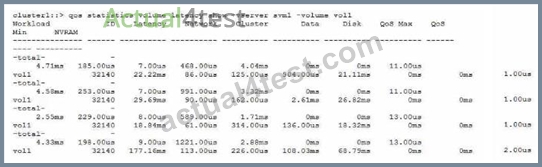
Referring to the exhibit, from which delay center is most of the latency for voll?
- A. NVRAM
- B. Data
- C. Disk
- D. Network
Answer: B
Explanation:
. Data. However, I cannot guarantee the accuracy or completeness of this answer, and you should verify it with the NetApp Support Engineer ONTAP Specialist documents and learning resources.
Here are some references that might help you:
1: qos statistics volume latency show - NetApp 2: How to use and understand qos statistics commands to monitor volume latency in real time - NetApp Knowledge Base
NEW QUESTION # 28
Which two throughput elements are controlled by host applications? (Choose two.)
- A. latency
- B. concurrency
- C. operation size
- D. Jitter
Answer: B,C
Explanation:
The two throughput elements that are controlled by host applications are operation size and concurrency. Operation size refers to the amount of data that is transferred in a single I/O request, and concurrency refers to the number of I/O requests that are issued simultaneously. Both of these factors affect the throughput of a host application, as they determine how much data can be sent or received within a given time period. Larger operation sizes and higher concurrency can increase the throughput, but they may also increase the latency and resource consumption12. Reference: 1: NetApp Performance Analysis on Data ONTAP - Chapter 3: Host-Side Performance 2: NetApp Performance Analysis on Data ONTAP - Chapter 4: Storage System Performance
NEW QUESTION # 29
Your customer has deployed a two petabyte NetAppONTAP FlexGroup volume across their 4-node ONIAP
9.8 cluster. They plan to store over three billion files. They want to prevent file 10 conflicts since files are
placed into the FlexGroup volume.
In this scenario, which two NFS SVM parameters should be enabled? (Choose two.)
- A. -v4-fsid-change
- B. -v4-64bit-idantifiers
- C. -v3-64bit-identifiers
- D. -v3-fsid-change
Answer: C,D
NEW QUESTION # 30
......
Free NS0-593 Exam Braindumps Network Appliance Pratice Exam: https://examtorrent.actual4test.com/NS0-593_examcollection.html