


Guaranteed Success in Splunk Enterprise Security Certified Admin SPLK-3001 Exam Dumps
Splunk SPLK-3001 Daily Practice Exam New 2026 Updated 101 Questions
NEW QUESTION # 47
Which of the following are the default ports that must be configured for Splunk Enterprise Security to function?
- A. SplunkWeb (8390), Splunk Management (8323), KV Store (8672)
- B. SplunkWeb (8043), Splunk Management (8088), KV Store (8191)
- C. SplunkWeb (8000), Splunk Management (8089), KV Store (8191)
- D. SplunkWeb (8068), Splunk Management (8089), KV Store (8000)
Answer: C
Explanation:
https://docs.splunk.com/Documentation/Splunk/8.1.2/Security/SecureSplunkonyournetwork
NEW QUESTION # 48
A site has a single existing search head which hosts a mix of both CIM and non-CIM compliant applications. All of the applications are mission-critical. The customer wants to carefully control cost, but wants good ES performance. What is the best practice for installing ES?
- A. Increase the number of CPUs and amount of memory on the search head, then install ES.
- B. Install ES on the existing search head.
- C. Delete the non-CIM-compliant apps from the search head, then install ES.
- D. Add a new search head and install ES on it.
Answer: D
Explanation:
Reference:
https://www.splunk.com/pdfs/technical-briefs/splunk-validated-architectures.pdf
NEW QUESTION # 49
Where are attachments to investigations stored?
- A. attachments.csv lookup
- B. <splunk_home>/etc/apps/SA-Investigations/default/ui/views/attachments
- C. KV Store
- D. notable index
Answer: C
NEW QUESTION # 50
The Brute Force Access Behavior Detected correlation search is enabled, and is generating many false positives. Assuming the input data has already been validated. How can the correlation search be made less sensitive?
- A. Edit the search, look for where or xswhere statements, and after the threshold value being compared to make it less common match.
- B. Edit the search, look for where or xswhere statements, and alter the threshold value being compared to make it a more common match.
- C. Edit the search and modify the notable event status field to make the notable events less urgent.
- D. Modify the urgency table for this correlation search and add a new severity level to make notable events from this search less urgent.
Answer: A
Explanation:
Reference:
https://docs.splunk.com/Documentation/ES/6.1.0/User/Howurgencyisassigned
NEW QUESTION # 51
What is an example of an ES asset?
- A. People
- B. Server
- C. MAC address
- D. User name
Answer: B
Explanation:
Explanation
According to the Splunk Enterprise Security documentation, an asset is a physical or logical device that is part of your network infrastructure, such as a server, a workstation, a router, or a firewall. An asset can have various attributes, such as IP address, MAC address, DNS name, NT host name, priority, business unit, owner, and others. Splunk Enterprise Security uses asset data to enrich and correlate security events and provide context for analysis. You can manage asset data using the Asset and Identity Management page in Splunk Enterprise Security. See Manage assets and identities in Splunk Enterprise Security for more details.
The other options are not examples of ES assets, but they may be related to other types of data. A MAC address is an attribute of an asset, not an asset itself. A user name is an example of an identity, which is a person or group that is associated with an asset or an event. Splunk Enterprise Security uses identity data to enrich and correlate security events and provide context for analysis. You can manage identity data using the Asset and Identity Management page in Splunk Enterprise Security. See Manage assets and identities in Splunk Enterprise Security for more details. People is a data model in the Splunk Common Information Model (CIM), which provides a common standard for organizing and naming data fields across different data sources.
Splunk Enterprise Security uses the CIM to enable cross-source analysis and correlation of security events.
The People data model contains the fields and tags for events that are related to people, such as user names, email addresses, phone numbers, and others. See People for more details. Therefore, the correct answer is C.
Server. References =
Manage assets and identities in Splunk Enterprise Security
People
NEW QUESTION # 52
Which of the following actions can improve overall search performance?
- A. Increase priority of all correlation searches.
- B. Add notable event suppressions for correlation searches with high numbers of false positives.
- C. Disable indexed real-time search.
- D. Reduce the frequency (schedule) of lower-priority correlation searches.
Answer: B,D
NEW QUESTION # 53
The Remote Access panel within the User Activity dashboard is not populating with the most recent hour of data. What data model should be checked for potential errors such as skipped searches?
- A. Performance
- B. Authentication
- C. Risk
- D. Web
Answer: B
Explanation:
Explanation
The Remote Access panel within the User Activity dashboard is based on the Authentication data model, which contains information about authentication events from various sources, such as VPN, SSH, RDP, and others. The Authentication data model is accelerated by default, which means that it generates summary data to speed up searches. However, if the summary data is not up to date, the dashboard panel may not show the most recent data. This can happen if the data model acceleration search is skipped, disabled, or encountering errors12. To check the status of the data model acceleration, you can use the Data Model Audit dashboard in the Monitoring Console3 or the | datamodel command in the Search app4. References = 1: User Activity Monitoring - Splunk Documentation - Remote Access. 2: About data model acceleration - Splunk Documentation. 3: Use the Data Model Audit dashboard - Splunk Documentation. 4: datamodel - Splunk Documentation.
NEW QUESTION # 54
The Add-On Builder creates Splunk Apps that start with what?
- A. DA-
- B. TA-
- C. SA-
- D. App-
Answer: B
Explanation:
Reference:
https://dev.splunk.com/enterprise/docs/developapps/enterprisesecurity/abouttheessolution/
NEW QUESTION # 55
How does ES know local customer domain names so it can detect internal vs. external emails?
- A. Web and email domain names are set in General -> General Configuration.
- B. ES extracts local email and web domains automatically from SMTP and HTTP logs.
- C. The Corporate Web and Email Domain Lookups are edited during initial configuration.
- D. ES uses the User Activity index and applies machine learning to determine internal and external domains.
Answer: C
NEW QUESTION # 56
Adaptive response action history is stored in which index?
- A. cim_adaptiveactions
- B. modular_action_history
- C. cim_modactions
- D. modular_history
Answer: C
Explanation:
Explanation/Reference: https://docs.splunk.com/Documentation/ES/6.1.0/Install/Indexes
NEW QUESTION # 57
Which of the following is a risk of using the Auto Deployment feature of Distributed Configuration Management to distribute indexes.conf?
- A. Indexes might be processing.
- B. Indexes might crash.
- C. Indexes might not be reachable.
- D. Indexes have different settings.
Answer: D
Explanation:
Explanation
The Auto Deployment feature of Distributed Configuration Management is a tool that allows you to automatically distribute configuration files, such as indexes.conf, to your Splunk platform instances. However, using this feature to distribute indexes.conf can pose a risk of having indexes with different settings across your instances. This can happen if you have manually edited the indexes.conf file on some of your instances, or if you have different versions of Splunk Enterprise Security installed on different instances. If the indexes have different settings, such as retention policies, storage paths, or bucket sizes, this can cause data inconsistency, search inefficiency, or data loss. Therefore, it is recommended to use the Manual Deployment feature of Distributed Configuration Management to review and validate the indexes.conf file before deploying it to your instances12. References = 1: Distributed Configuration Management - Splunk Documentation - Auto Deployment. 2: Distributed Configuration Management - Splunk Documentation - Manual Deployment.
NEW QUESTION # 58
Which of the following is a recommended pre-installation step?
- A. Configure search head forwarding.
- B. Download the latest version of KV Store from MongoDBxom.
- C. Disable the default search app.
- D. Install the latest Python distribution on the search head.
Answer: A
Explanation:
Explanation
According to the Splunk Enterprise Security documentation, one of the recommended pre-installation steps is to configure search head forwarding. Search head forwarding is a feature that allows the search head to forward its internal logs and metrics to an indexer or a heavy forwarder for indexing and analysis. This feature helps you monitor the health and performance of the search head and troubleshoot any issues that may arise.
You can configure search head forwarding by editing the outputs.conf file on the search head and specifying the destination indexer or forwarder. See Configure search head forwarding for more details.
The other options are not recommended, because they are either unnecessary or harmful for the installation of ES. Disabling the default search app is not a good option, because it may cause some features of ES to not work properly, such as the Content Management page and the navigation editor. Downloading the latest version of KV Store from MongoDB.com is not a good option, because ES uses the built-in KV Store service that comes with Splunk Enterprise and does not require any external installation or configuration. Installing the latest Python distribution on the search head is not a good option, because it may cause compatibility issues with ES, which uses the Python version that comes with Splunk Enterprise. Therefore, the correct answer is B. Configure search head forwarding. References = Configure search head forwarding.
NEW QUESTION # 59
What role should be assigned to a security team member who will be taking ownership of notable events in the incident review dashboard?
- A. ess_reviewer
- B. ess_admin
- C. ess_analyst
- D. ess_user
Answer: B
Explanation:
Explanation/Reference: https://docs.splunk.com/Documentation/ES/6.1.0/User/Triagenotableevents
NEW QUESTION # 60
When creating custom correlation searches, what format is used to embed field values in the title, description, and drill-down fields of a notable event?
- A. $fieldname$
- B. "fieldname"
- C. %fieldname%
- D. _fieldname_
Answer: C
Explanation:
Reference:
https://docs.splunk.com/Documentation/ITSI/4.4.2/Configure/Createcorrelationsearch
NEW QUESTION # 61
What are the steps to add a new column to the Notable Event table in the Incident Review dashboard?
- A. Configure -> Content Management -> Type: Correlation Search
- B. Configure -> Incident Management -> Incident Review Settings -> Table Attributes
- C. Configure -> Incident Management -> Incident Review Settings -> Event Management
- D. Configure -> Incident Management -> Notable Event Statuses
Answer: C
Explanation:
Explanation/Reference: https://docs.splunk.com/Documentation/ES/6.1.0/Admin/Customizenotables
NEW QUESTION # 62
When ES content is exported, an app with a .spl extension is automatically created. What is the best practice when exporting and importing updates to ES content?
- A. Use new app names each time content is exported.
- B. Either use new app names or always include both existing and new content.
- C. Do not use the .spl extension when naming an export.
- D. Always include existing and new content for each export.
Answer: B
Explanation:
Explanation
Either use new app names each time (which could be difficult to manage) or make sure you always include all content (old and new) each time you export.
NEW QUESTION # 63
What does the Security Posture dashboard display?
- A. A display of the status of security tools.
- B. Active investigations and their status.
- C. A high-level overview of notable events.
- D. Current threats being tracked by the SOC.
Answer: C
Explanation:
Explanation
The Security Posture dashboard is designed to provide high-level insight into the notable events across all domains of your deployment, suitable for display in a Security Operations Center (SOC). This dashboard
NEW QUESTION # 64
The Remote Access panel within the User Activity dashboard is not populating with the most recent hour of data. What data model should be checked for potential errors such as skipped searches?
- A. Performance
- B. Web
- C. Authentication
- D. Risk
Answer: B
NEW QUESTION # 65
Both "Recommended Actions" and "Adaptive Response Actions" use adaptive response. How do they differ?
- A. Recommended Actions show a list of Adaptive Responses to an analyst, Adaptive Response Actions run them automatically.
- B. Recommended Actions show a list of Adaptive Resposes to an analyst, Adaptive Response Actions run manually with analyst intervention.
- C. Recommended Actions show a textual description to an analyst, Adaptive Response Actions show them encoded.
- D. Recommended Actions show a list of Adaptive Responses that have already been run, Adaptive Response Actions run them automatically.
Answer: B
Explanation:
Explanation/Reference: https://docs.splunk.com/Documentation/ES/latest/Admin/Configureadaptiveresponse
NEW QUESTION # 66
Which component normalizes events?
- A. Technology add-on.
- B. ES application.
- C. SA-CIM.
- D. SA-Notable.
Answer: A
Explanation:
Explanation
A technology add-on (TA) is a Splunk app that contains the configurations for ingesting and normalizing data from a specific data source or vendor. A TA can include sourcetype definitions, index-time and search-time field extractions, event types, tags, lookups, and other settings that help to map the data to the Splunk Common Information Model (CIM). The CIM is a set of predefined data models that provide a common standard for organizing and naming data fields across different data sources. Splunk Enterprise Security uses the CIM to enable cross-source analysis and correlation of security events. Therefore, the correct answer is D.
Technology add-on. References =
Technology add-ons overview
Splunk Common Information Model Add-on
Normalizing Enterprise Security data with technology add-ons
Onboarding data to Splunk Enterprise Security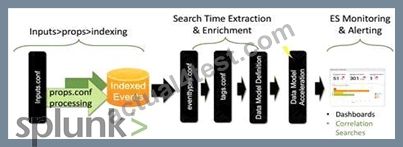
NEW QUESTION # 67
Which of the following is part of tuning correlation searches for a new ES installation?
- A. Configuring correlation adaptive responses.
- B. Configuring correlation notable event index.
- C. Configuring correlation result storage.
- D. Configuring correlation permissions.
Answer: A
Explanation:
Explanation
Correlation searches can perform adaptive response actions when they find a pattern in the data. Adaptive response actions are automated or manual responses that you can use to modify your environment based on notable events. For example, you can block an IP address, add a user to a watchlist, or send an email notification. Configuring correlation adaptive responses is part of tuning correlation searches for a new ES installation, as it allows you to customize the actions that are triggered by the correlation searches. You can enable, disable, or modify the adaptive response actions for each correlation search, or create your own custom actions. References = Configure correlation searches in Splunk Enterprise Security Adaptive Response Framework overview
NEW QUESTION # 68
Which indexes are searched by default for CIM data models?
- A. _internal and summary
- B. All indexes
- C. summary and notable
- D. notable and default
Answer: B
Explanation:
Reference:
https://answers.splunk.com/answers/600354/indexes-searched-by-cim-data-models.html
NEW QUESTION # 69
......
Splunk SPLK-3001 (Splunk Enterprise Security Certified Admin) Exam is designed to test the skills and knowledge of individuals who work with Splunk Enterprise Security. Splunk Enterprise Security Certified Admin Exam certification exam is intended for experienced Splunk users, administrators, and analysts who are responsible for managing and configuring Splunk Enterprise Security. SPLK-3001 exam is designed to validate the skills and knowledge required to perform advanced security data analysis, create custom security content, and configure advanced security settings.
Test Engine to Practice SPLK-3001 Test Questions: https://examtorrent.actual4test.com/SPLK-3001_examcollection.html