


CCDE v3.0 400-007 Dumps | Updated Jul 24, 2026 - Actual4test
Master 2026 Latest The Questions CCDE v3.0 and Pass 400-007 Real Exam!
Candidates who successfully pass the Cisco 400-007 exam will be recognized as experts in network design and architecture, and will be highly sought after by employers in a variety of industries. They will have the skills and knowledge necessary to design and implement complex network architectures that can meet the needs of large organizations and enterprises.
NEW QUESTION # 252
An Agile for Infrastructure transition often means dismantling traditional IT hierarchies and rebuilding it to align with business objectives and workflows Organizations are seeing the benefits of using automation tools in the network such as faster more efficient more effective delivery of products and services. Which two components help increasing overall productivity and improve company culture? (Choose two.)
- A. Agile code practices
- B. controlled infrastructure
- C. dedicated infrastructure
- D. DevOps practices
- E. infrastructure-as-code
Answer: D,E
NEW QUESTION # 253
You are designing a large-scale DMVPN network with more than 500 spokes using EIGRP as the IGP protocol. Which design option eliminates potential tunnel down events on the spoke routers due to the holding time expiration?
- A. Increase the hold queue on the physical interface of the hub router
- B. Increase the hold queue on the tunnel interface of the hub router
- C. Increase the hold queue on the physical interface of the spoke routers
- D. Apply QoS for pak_priority class
- E. Increase the hold queue on the tunnel interface of the spoke routers
Answer: E
Explanation:
In DMVPN designs with many spokes, spokes may fail to receive periodic keepalives or routing updates if queues overflow during congestion, causing holding timers to expire and tunnels to flap. Increasing the hold queue size on the tunnel interface of the spoke routers allows them to buffer control plane packets during congestion and avoid premature tunnel teardown.
Why other options are incorrect:
* A, C, E: Physical interface queues do not directly affect tunnel protocol timers.
* D: QoS may help prioritize control plane traffic but doesn't address queue depth directly, which is the root cause of the issue.
-
NEW QUESTION # 254 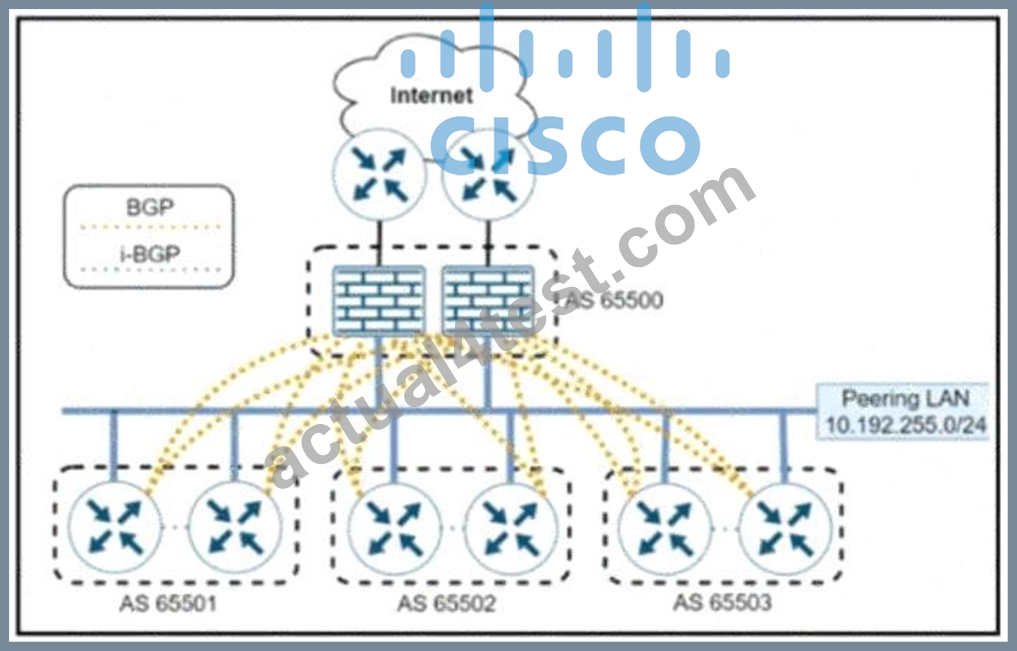
Refer to the exhibit in the topology, each router has a BGP session to each firewall in a hub-and-spoke BGP design The peering LAN implements an Ethernet Virtual Private LAN service from a service provider that offers carrier Ethernet services from its MPLS-enabled network Each router has an IP address in the 10.192
255.0/24 subnet. Spoke BGP routers must communicate with each other directly without traffic passing through the firewall AS PATH is used for policy enforcement.
How can BGP sessions be established between the routers and the firewalls?
- A. firewalls as route reflectors
- B. firewalls as route servers
- C. iBGP sessions
- D. eBGP sessions
Answer: D
NEW QUESTION # 255
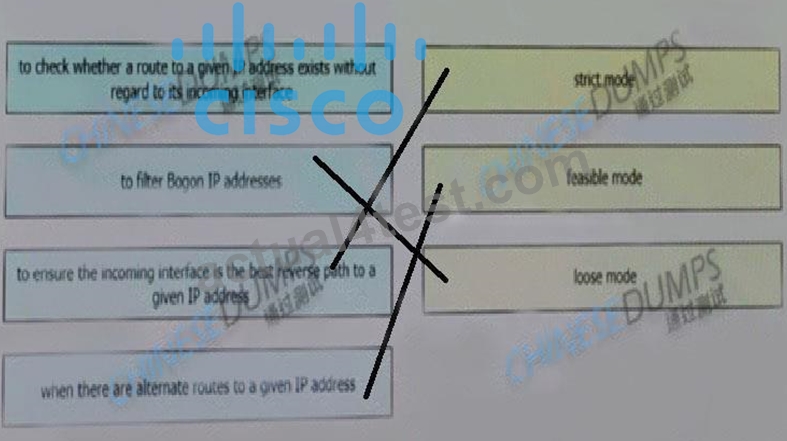
Drag and drop the design use cases from the left onto the correct uRPF techniques used to prevent spoofing attacks Not all options are used.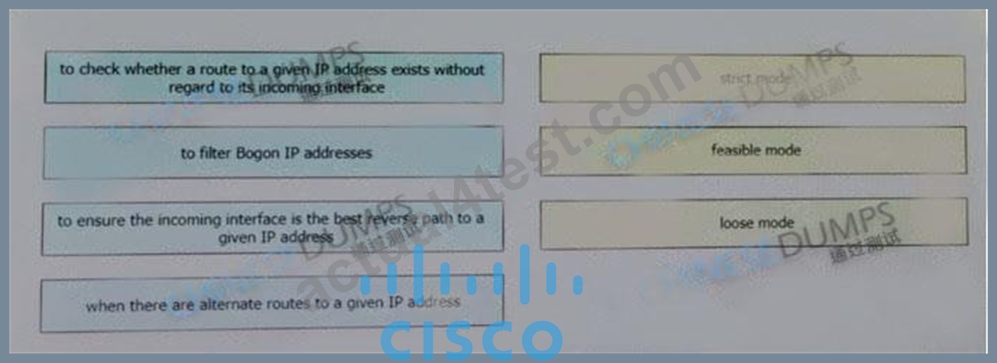
Answer:
Explanation: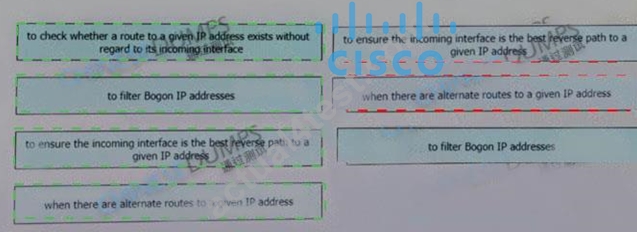
NEW QUESTION # 256
A banking customer determines that it is operating POS and POI terminals that are noncompliant with PCI DSS requirements, as it is running TLSv1.0. The customer plans to migrate the terminals to TLSv1.2. What are two requirements to complete the migration? (Choose two.)
- A. Maintain a policy that addresses information security for employees and third parties.
- B. Apply strong encryption for transmission of cardholder data across public networks.
- C. Apply strong cryptography and security protocols to safeguard sensitive cardholder data.
- D. Protect all user systems against malware and frequently update antivirus software
- E. Ensure that strong cryptography is applied for users who have administrative access through networks
Answer: B,C
Explanation:
https://www.securitymetrics.com/blog/what-are-12-requirements-pci-dss-compliance
NEW QUESTION # 257
What are two key design principles when using a hierarchical core-distribution-access network model? (Choose two )
- A. A hierarchical network design facilitates changes
- B. A hierarchical network design model aids fault isolation
- C. The core layer is designed first, followed by the distribution layer and then the access layer
- D. The core layer provides server access in a small campus.
- E. The core layer controls access to resources for security
Answer: A,B
NEW QUESTION # 258
An enterprise network has two core routers that connect to 200 distribution routers and uses full- mesh IBGP peering between these routers as its routing method. The distribution routers are experiencing high CPU utilization due to the BGP process.
Which design solution is the most cost effective?
- A. Implement route reflectors on the two core routers
- B. Implement e BGP between the core and distribution routers
- C. Increase the memory on the distribution routers
- D. Increase bandwidth between the core routers
- E. Increase the memory on the core routers
Answer: A
NEW QUESTION # 259
Company XYZ has 30 sites running a legacy private WAN architecture that connects to the Internet via multiple high- speed connections The company is now redesigning their network and must comply with these design requirements :
* Use a private WAN strategy that allows the sites to connect to each other directly and caters for future expansion.
* Use the Internet as the underlay for the private WAN.
* Securely transfer the corporate data over the private WAN.
Which two technologies should be Incorporated into the design of this network? (Choose two.)
- A. PPTP
- B. DMVPN
- C. GET VPN
- D. IPsec
- E. S-VTI
Answer: B,D
NEW QUESTION # 260
Which two protocols are used by SDN controllers to communicate with switches and routers?
(Choose two.)
- A. NetFlow
- B. Open vSwitch Database
- C. OpenFlash
- D. OpenFlow
- E. NetFlash
Answer: B,D
NEW QUESTION # 261
SDN emerged as a technology trend that attracted many industries to move from traditional networks to SDN.
Which challenge is solved by SDN for cloud service providers?
- A. complex and distributed management flow
- B. higher operating expense and capital expenditure
- C. exponential growth of resource-intensive application
- D. need for intelligent traffic monitoring
Answer: A
NEW QUESTION # 262
SDN is still maturing Throughout the evolution of SDN which two things will play a key role in enabling a successful deployment and avoiding performance visibility gaps in the infrastructure' (Choose two.)
- A. rapid on-demand growth
- B. integration of device context
- C. failing back to old behaviours
- D. peer-to-peer controller infrastructure
- E. dynamic real-time change
Answer: A,E
NEW QUESTION # 263
As the control plane receives discovered state information from the data plane. it compares it agains the desired state. Which process is used when the desired state does not match the actual state?
- A. Control directives.
- B. data segmentation.
- C. Distributed services.
- D. building blocks
Answer: A
Explanation:
In an intent-based or software-defined network, when the control plane detects that actual state differs from desired state, it issues control directives to reconfigure devices and restore the desired state.
NEW QUESTION # 264
Which two characteristics apply to firewall transparent mode operations in a firewall solution design?
(Choose two.)
- A. The firewall can participate actively on spanning tree.
- B. Changes in the existing IP addressing and subnets are required
- C. Multicast traffic can traverse the firewall.
- D. The firewall acts like a router hop in the network.
- E. OSPF adjacencies can be established through the firewall
Answer: A,C
Explanation:
* B: In transparent mode, the firewall operates at Layer 2 and can participate in STP to avoid loops.
* C: Multicast traffic can traverse the firewall if allowed through transparent bridging rules.
Why other options are incorrect:
* A: Transparent mode requires no change to IP addressing.
* D: Transparent firewalls do not form routing adjacencies.
* E: Routed mode firewalls operate at Layer 3; transparent mode does not insert router hops.
-
NEW QUESTION # 265
Over the years, many solutions have been developed to limit control plane state, which reduces the scope or the speed of control plane information propagation. Which solution removes more specific information about a particular destination as topological distance is covered in the network?
- A. aggregation
- B. back-off timers
- C. summarization
- D. layering
Answer: C
Explanation:
Summarization is the process of combining more specific routes into a single, broader route to reduce the size of the routing table and limit the amount of control plane state. This reduces the amount of information that needs to be propagated through the network as the topological distance increases.
NEW QUESTION # 266
Company XYZ is in the process of identifying which transport mechanism(s) to use as their WAN technology. Their main two requirements are.
* a technology that could offer DPI, SLA, secure tunnels, privacy, QoS, scalability, reliability, and ease of management
* a technology that is cost-effective
Which WAN technology(ies) should be included in the design of company XYZ?
- A. Software-defined WAN should be the preferred choice because it complements both technologies, covers all the required features, and it is the most cost-effective solution.
- B. Both technologies should be used. Each should be used to back up the other one; where the primary links are MPLS, the internet should be used as a backup link with IPsec (and vice versa).
- C. MPLS meets all these requirements and it is more reliable than using the Internet. It is widely used with defined best practices and an industry standard.
- D. Internet should be the preferred option because it is cost effective and supports BFD, IP SLA. and IPsec for secure transport over the public Internet.
Answer: A
NEW QUESTION # 267
Company XYZ Is running a redundant private WAN network using OSPF as the underlay protocol The current design accommodates for redundancy In the network, but it Is taking over 30 seconds for the network to reconverge upon failure Which technique can be Implemented In the design to detect such a failure in a subsecond?
- A. fate sharing
- B. OSPF LFA
- C. flex links
- D. BFD
- E. STP
Answer: C
NEW QUESTION # 268
Company XYZ, a global content provider, owns data centers on different continents. Their data center design involves a standard three-layer design with a Layer 3-only core. HSRP is used as the FHRP. They require VLAN extension across access switches in all data centers, and they plan to purchase a Layer 2 interconnection between two of their data centers in Europe. In the absence of other business or technical constraints, which termination point is optimal for the Layer 2 interconnection?
- A. at the aggregation layer because it is the Layer 2 to Layer 3 demarcation point
- B. at the core layer, to offer the possibility to isolate STP domains
- C. at the core layer because all external connections must terminate there for security reasons
- D. at the access layer because the STP root bridge does not need to align with the HSRP active node
Answer: A
Explanation:
In a standard 3-tier data center architecture (access, aggregation, core), the Layer 2-to-Layer 3 boundary typically resides at the aggregation layer. When extending VLANs between data centers using a Layer 2 interconnection, the most optimal and scalable termination point is at the aggregation layer because:
* It naturally handles VLAN demarcation and Layer 3 boundary.
* Spanning Tree Protocol (STP) domains remain contained within local aggregation blocks.
* The core remains Layer 3-only, ensuring scalability, stability, and no STP involvement.
* Simplifies traffic engineering, FHRP operations, and minimizes control-plane complexity across sites.
This design is consistent with CCDE v3.1 best practice where VLAN extension is isolated to aggregation to avoid STP scaling issues and maintain hierarchical design principles.
Why other options are incorrect:
* A: STP isolation can still be achieved at aggregation while keeping the core Layer 3.
* C: Access layer extensions would increase STP scope and complexity unnecessarily.
* D: Core termination violates Layer 3 core design, bringing STP into the core, which is not scalable.
NEW QUESTION # 269
The General Bank of Greece plans to upgrade its legacy, end-of-life WAN network with a new flexible, manageable, and scalable solution. The main requirements are ZTP support, end-to-end encryption, application awareness, and segmentation. The CTO states that the main goal of the bank is CAPEX reduction. Which WAN technology should be used for the solution?
- A. DMVPN with PfR
- B. managed SD-WAN
- C. SD-WAN
- D. SD-branch
Answer: B
NEW QUESTION # 270
The Company XYZ network is experiencing attacks against their router. Which type of Control Plane Protection must be used on the router to protect all control plane IP traffic that is destined directly for one of the router interfaces?
- A. Control Plane Protection main interface
- B. Control Plane Protection CEF-exception subinterface
- C. Control Plane Protection host subinterface
- D. Control Plane Protection transit subinterface
Answer: C
Explanation:
* The Host Subinterface in Control Plane Protection (CPPr) protects traffic destined to the router itself (e.
g., routing protocols, management traffic).
* This is critical in preventing DoS or CPU exhaustion attacks targeting control plane services directly.
Why other options are incorrect:
* B: Main interface refers to the global control plane policy but lacks the granularity.
* C: Transit subinterface protects transit traffic handled by the forwarding plane.
* D: CEF-exception handles non-IP or exception traffic, not regular control plane IP traffic.
-
NEW QUESTION # 271
Which interface allows a controller to program the data plane forwarding tables of a networking device?
- A. Northbound interface
- B. Controller interface
- C. Southbound interface
- D. Application programming interface
Answer: C
Explanation:
# Explanation:
B: The southbound interface connects the SDN controller to the networking devices (e.g., switches/routers).
Protocols like OpenFlow, NETCONF, or OpFlex allow the controller to program flow tables and influence forwarding behavior.
Other options:
A: "Controller interface" is not a standard architectural term.
C: APIs are a general concept; the specific interface for data-plane programming is southbound.
D: Northbound interfaces connect applications to the controller-not to devices.
#
NEW QUESTION # 272
......
A fully updated 2026 400-007 Exam Dumps exam guide from training expert Actual4test: https://examtorrent.actual4test.com/400-007_examcollection.html